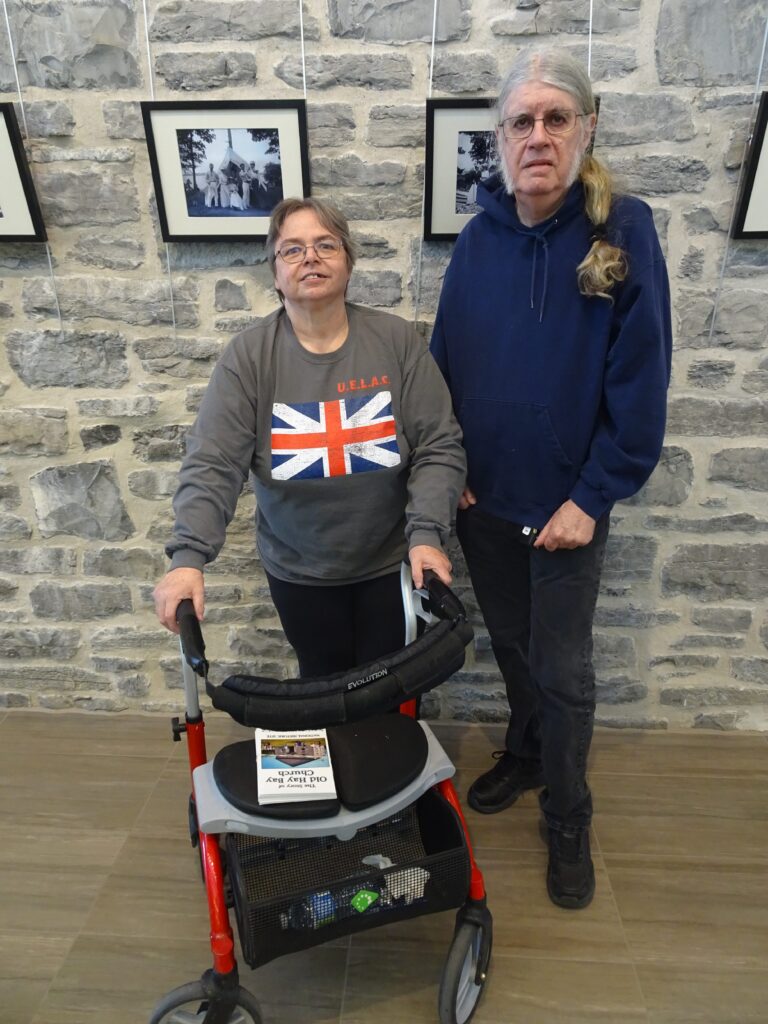

Documenting Your Loyalist Ancestor
(A talk by Angela and Peter Johnson, Dominion Genealogists for UELAC)
Saturday, March 23, 2019
Their talk was entitled “Documenting your Loyalist Ancestor”. When proving Loyalist descent, the goal is to document each generation, e.g. that you are your mother’s daughter, that she was her father’s daughter, etc. The first rule-of-thumb that Angela and Peter articulated was “Look first for primary sources. These are the registrations of births, marriages and deaths. They are the only sources that stand alone.”
Other sources which can provide information on relationships include, but are not limited to:
- Census records, some of which go back to 1803
- Baptismal records are very helpful, when they give the names of parents
- Wills are also an important resource because they name the children of the testator
- Land Petitions. In a petition, the petitioner explains why he is entitled to land or why he should receive even more land than already granted. Upper Canada Land Petitions are all available online, and they are free. The researcher should look not just at the petition but at the outside cover, because that’s where it states what the petitioner got. Was his petition successful, partly successful, or did it fail?
- Family Bibles are another valuable source. However, the researcher is advised to check the title page to find out when the Bible was printed. The listing of a birth, marriage or death that occurred years before the Bible was even printed obviously carries no authority.
- Grave markers in old cemeteries often give information about the family of the person buried there.
- Loyalist regiment discharge certificates are another source, though of varying value. Those of the King’s Royal Rangers of New York contain many helpful details, such as the discharged soldier’s parents’ names and where he came from. The discharge papers of Butler’s Rangers, on the other hand, contain little detail. Regiment Muster Rolls are also of significant help.
- War Losses Claims, which are available on “Ancestry.ca”, may yield useful information.
Peter and Angela warned the audience that the same Christian name was often given frequently within the same family, so that care must be taken not to confuse father, son, uncle, cousin or nephew who all have exactly the same first and last names.
Another warning concerned how to handle documents used to obtain a UEL Certificate. Never, the audience was told, use a highlighter. To call something to the genealogist’s attention, underline the words or make a note in the margin, or affix a “post-it” note.
Their talk was followed by an extended question period.