
How the Deal Went Down: Indigenous People and the Establishment of Kingston, 1783
(a talk by Dr. Laura Murray)
March 25, 2017
 Dr. Laura Murray, Professor of English and Cultural Studies at Queen’s University, spoke on “How the Deal Went Down: Indigenous People and the Establishment of Kingston, 1783.”
Dr. Murray explained that the First Nation group primarily occupying the Kingston area at the end of the American Revolution were Algonquians, specifically the Mississauga. Those with whom the Loyalists had collaborated during the Revolution, who had fought alongside the British forces, were primarily Iroquois, who lived in New York province. The two groups had quite different language and culture, and should not be thought of as unified.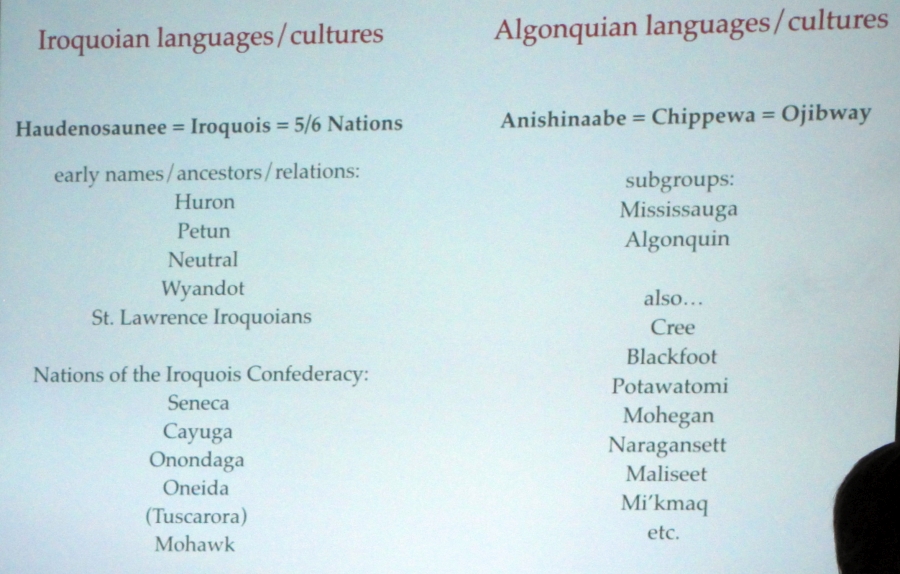
Laura mentioned that it is often said that Cataraqui means “place where there is clay” or “where the limestone is”. However, her studies lead her to believe that Katarokwi derives from the Huron language and means “Swampy Place”. This certainly fits the area around the Inner Harbour where Indigenous trading encampments were just outside the perimeter of the original Fort Frontenac.
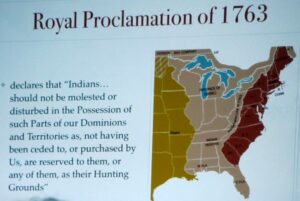 Laura discussed the Royal Proclamation of 1763, which reinforced the rights of First Nations to their historic hunting lands. The red area on the map represents the western edge of the 13 Colonies. Colonists could not claim lands individually west of that line into the beige-coloured area, but there was great pressure on the government to let the
colonies expand westward. This Proclamation became one reason why many Iroquois sided with the British against the Americans during the Revolution, believing that the British would preserve their hunting grounds.
Laura went on to show some interesting letters exchanged between Governor Haldimand and people such as the surveyors Samuel Holland and John Collins, Major Ross, and Sir John Johnson. Haldimand wanted to obtain land for Loyalists, but he also had to tread carefully between the Mississauga who were currently on the land, and Joseph Brant and the Mohawks who were being driven out of New York and expected to be compensated. In September 1783, Haldimand wrote to Major Ross,
From the Report of Sir John Johnson I have reason to expect that the Mohawks, and some other Tribes of Savages will establish themselves near the Bay of Kintie, and I understand it is their Wish to have the Loyalists in their Neighbourhoods all which I think will be an Advantage, by rendering the Settlement respectable, and consequently secure. The only difficulty seems to be, giving uneasiness to the Missisagues, as they claim The Northern Part of Lake Ontario, to avoid which, I have directed Sir J. Johnson to treat with them on this Matter and if necessary to make such purchases as the King’s Service may require, which he tells me will easily be accomplished.
This led to the “Crawford Purchase” from the Mississaugas of “all the Lands from Toniata or Ouagara River [Jones Creek near present-day Mallorytown] to a River in the Bay of Quentie [near Belleville] within Eight Leagues of the Bottom of said Bay including all the Islands, extending from the Lake Back as far as a man can Travil in a day.” This distance came to be interpreted as 2 or 3 townships in depth, as far as Tamworth on the west and Westport on the east.
On 18 October 1783, Johnson wrote to Haldimand, “I transmit herewith Captain Crawford’s Letter relative to the purchase of the Lands from the Messasagas, which I hope will prove agreeable to your Excellency’s wishes, and I shall be glad to receive directions concerning the deed of Cession necessary to be created upon the occasion.” However, if the Deed was created, it cannot now be found so it is not certain if this was done. Nowhere in the letter documenting the Crawford Purchase is it indicated that the Mississauga swore allegiance to the King or intended to give away their lands.
Then, in June 1784, the Loyalists began to arrive.