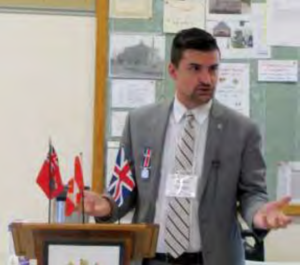

Exploring Kinship Through Her Majesty’s Chapels Royal
(a talk by Nathan Tidridge)
November 23, 2020
Nathan Tildridge, a high school history teacher from Waterdown, Ontario, was named the first UELAC Honorary Fellow in 2018. Nathan’s topic for us was “Exploring Kinship Through Her Majesty’s Chapels Royal.”
Nathan explained that in medieval England, the “Chapel Royal” was the retinue of clergy who followed the sovereign around the country as he moved about. By the time of the Stuart monarchs, the Chapel Royal began to be associated with physical places: there are seven in the UK, the most senior being Her Majesty’s Chapel Royal of St. James Palace, considered the Queen’s personal chapel.
Nathan explained first about the role of Treaties in Canadian history. A Treaty between the Crown and indigenous peoples was never designed to be a contract. Instead, it supposed there was a familial relationship between the two parties, an expression of love and affection. Treaties use abstract words like honour, since native languages are more allegorical than is English. Treaties were always marked by much ceremony and protocol, since “a ceremony focuses attention so that it becomes intention,” said Nathan (quoting Robin Wall Kimmerer’s Braiding Sweetgrass).
One of the first major treaties reached in Canada was the Treaty of Niagara in 1764. About 2,000 indigenous people from many nations gathered to meet with Sir William Johnson so he could explain the Royal Proclamation of 1763 after England had defeated the French and laid claim to all of eastern Canada. Molly Brant was probably the designer of the Covenant Chain Wampum belt, although it would have been made by one of the King’s artificers. As well as receiving the Wampum belt from Johnson, the native leaders and he would have exchanged gifts including tobacco. In native tradition there are four plants of importance: sweet-grass, sage, red cedar and tobacco, with tobacco being the most significant. All of these traditions came into play when the third Chapel Royal in Canada was officially created at Massey College, University of Toronto, on 21 June 2017.
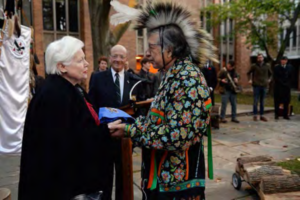 [Photo courtesy Nathan Tidridge: Lt-Governor of Ontario Elizabeth Dowdeswell presents gift of tobacco to Elder Garry Sault as Hugh Segal, then Principal of Massey College, looks on.]
The design of the Chapel incorporates the image of the 1764 Covenant Chain Wampum as part of its decoration. The occasion also included a visit from Canon Paul Wright, SubDean of Her Majesty’s Chapel Royal at St. James Palace, bringing gifts from Her Majesty to her new chapel. She gave a Bible signed by her, and her father George VI’s copy of the Anglican Book of Common Prayer.
But if it’s the third Chapel Royal in Canada, what of the other two? How did they come to be? In 1710, four “Indian Kings” travelled to England to meet with Queen Anne and asked her to provide a chaplain to teach their people about Christianity. She did so, establishing a Chapel Royal at Fort Hunter in New York Province. She also sent gifts of silver – bells, a communion set and other objects – and a giant Bible as well as altar cloths and vestments. During the American Revolution, while their farms were being torched by the rebels, the Mohawks buried all these precious objects to hide them. After the Revolution they were dug up and reclaimed, although the textile items were never found.
When the Mohawks came to Upper Canada along with other Loyalists, one group were given land on the Grand River, now the Six Nations Reserve, and another settled at Tyendinaga west of Kingston. Two new chapels were erected, and the silver items were divided between them. Since the chapel at Six Nations was the first built, in 1785, it became custodian of Queen Anne’s Bible. Christ Church at Tyendinaga was erected in 1843, replacing the former log church of St. George.
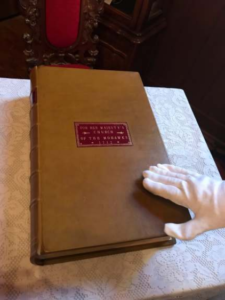 Nathan had the honour of travelling with Canon Paul Wright to visit the Chapel Royal at Brantford after the ceremony inaugurating the one at Massey College, which meant that he got to see the Queen Anne Bible, which had been brought which had been brought out of its special storage for the occasion. Inside the Bible are pages with signatures from each time a member of the royal family has visited the Chapel. Note George VI signed in 1939 [top of right-hand page], and the rest are signatures of Elizabeth R (several times), Prince Philip, and Prince Charles.
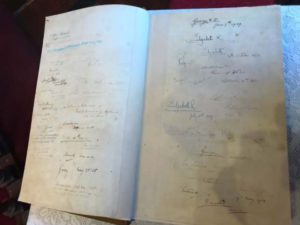 Opposite this page are signatures of various governors-general.
The Queen has always gone to the Chapel of the Mohawks at Brantford each time she has visited Canada. On her last visit in 2010, she gave a set of hand bells to six Clan Mothers.
The Chapel Royal at Brantford now has the first female indigenous Royal Chaplain, Rev. Rosalyn Elm.
[Note: The Chapel Royal at Tyendinaga has a slightly different history. See the website http://www.parishoftyendinaga.org/chapelroyal.htm. The original Christ Church congregation has now been merged with All Saints’ Anglican, and is under the Bishop of Ontario, rather than the Bishop of London as is the Brantford Chapel.]
In June 2019 the Massey College Chapel convened a conference of all Lieutenant Governors across Canada, the Governor-General, and National Grand Chief Perry Bellegarde. Chief Bellegarde clearly differentiated the Crown from the Canadian government. Since it is not a colonial institution, the Crown provides a mechanism to reengage and bind us all together. As Nathan said, “Canada Day does not mark the beginning of the nation of Canada, it is merely the anniversary of the Act of Confederation. Canada is a land thick with story and ancient relationships.”
Nathan Tidridge’s Publications
The Queen at the Council Fire: The Treaty of Niagara, Reconciliation, and the Dignified Crown in Canada – Dundurn Press, 2015
Prince Edward, Duke of Kent: Father of the Canadian Crown – Dundurn Press, 2013
Canada’s Constitutional Monarchy – Dundurn Press, 2011
Nathan has also contributed chapters to The Canadian Kingdom: 150 Years of Constitutional Monarchy, ed. D. Michael Jackson (Dundurn, 2018) and Royal Progress: Canada’s Monarchy in the Age of Disruption, ed. D. Michael Jackson (Dundurn, February 2020 release)
All are available as both hard copy and as epub, from Dundurn Press or Amazon.ca.
The Extraordinary History of Flamborough: East Flamborough, West Flamborough & Waterdown – Waterdown-East Flamborough Heritage Society, 2017
Beyond Mainland: Exploring History and Identity in Cottage Country – Stone Soup Publications, 2009 (currently out-of-print)