
The Education of a Leader: Joseph Brant and the School that became Dartmouth College
(a talk by Jean Rae Baxter)
November 22, 2014
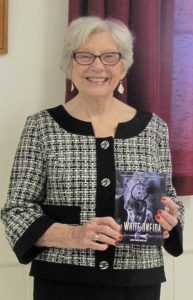
Jean Rae Baxter spoke on “The Education of a Leader: Joseph Brant and the School that became Dartmouth College”. Jean is a former English teacher at Napanee District High School. Now retired to Hamilton, she has written a number of historical novels for young adults, all dealing with Loyalist themes. As she said, by the time she published her third book, her publisher said “Now we have a trilogy.” Her fourth novel was published this year and her fifth is well under way, so now the publisher is calling it the “Forging Canada” series … leaving the number open-ended!
Joseph Brant was born in 1743 in Ohio Territory. His father was a Mohawk named Tehowah-wengaragh-kwin, which means “A man taking off his snowshoes.” Joseph’s Mohawk name was Thayendanegea. His father and mother (known to us only as Margaret, likely a name bestowed on her when she became a Christian) also had two children who died young before their daughter Molly was born in 1736. Tehowah-wengaragh-kwin died, and Molly and Joseph’s mother Margaret married a man named Brant Canagaraduncka, an important sachem among the Mohawks. They adopted his name “Brant” as their surname. Their new stepfather was a man of importance: archaeological digs have shown that his house in Canajoharie, New York Province had a stone cellar, clapboard siding, glass windows, and stone fireplaces. Brant Canagaraduncka’s home was a frequent stopping place for Sir William Johnson, Superintendent of Indian Affairs. Sir William acquired much land and wealth, and was the largest slave owner in the north (15). As most readers will know, he entered a relationship with Joseph’s sister Molly, who bore him eight children.
Sir William also took an interest in Joseph Brant and when he was 18, in 1761, he was one of 3 boys recommended that year by Sir William to Rev. Eleazar Wheelock, a Congregational minister who set up the Moor Indian Charity School in Lebanon CT. The prep school was established by the Scottish Society for the Propagation of Christian Knowledge in the Highlands and Islands and Foreign Parts of the World. Its purpose was to teach basic reading and writing to natives of both genders: in 1761 when Joseph attended school there were 15 boys and 7 girls representing 10 differnt tribes. It was also intended to provide the training they might need to become missionaries to their own people. Jean Rae Baxter’s latest novel, The White Oneida, contains a fictitious account of life at such a school, based in part on the Moor School records which survive.
The Moor School was so successful that by 1769, Wheelock recognized the need to establish a college at a more advanced level, and created Dartmouth College. Its motto still is Vox Clamantis in Deserto, “a voice crying in the wilderness”. The college was named for the Earl of Dartmouth, the largest donor when another native student, Samson Occom (the first student Wheelock tutored before founding his school) completed two years of fundraising up and down the United Kingdom. Samson had astonished Rev. Wheelock by learning Latin, Greek and Hebrew in addition to English.
Sir William Johnson withdrew Joseph from the school after two years, wanting him to attend King’s College in New York City, but the 1764 Pontiac Rebellion intervened. Instead, Sir William entrusted his education to a tutor, Cornelius Bennett, who unfortunately left very soon to avoid a smallpox epidemic in 1765. After that, Joseph Brant was hired as an interpreter for the British. He married an Oneida girl named Peggy and they farmed near Canajoharie.
In 1770 Joseph met Rev. John Stuart, and when Peggy died in 1771, Stuart invited Joseph to live with his family in the Fort Hunter parsonage. Together they translated the Anglican Prayer Book and the Gospel of Mark into the Mohawk language.
Education was always important to Joseph Brant. He sent his own sons to Moor School, and the first teacher at the school in Brantford, Upper Canada established after the Mohawks settled on the Six Nations Reserve was Paulus, a graduate of Moor School. A later schoolmaster at the Brantford school was George Johnson, a son of Sir William Johnson and Molly Brant.
Joseph’s third son, John, was elected to the Upper Canada Assembly in 1830 and was the first native member of an elected assembly in Canada. However, his election was challenged because he was not a property owner — since the Six Nations owned their land grant along the Grand River communally. His opponent John Warren was declared elected in 1831. John protested, but the issue became moot when both John Brant and his challenger died of cholera during the 1832 epidemic.
Joseph got in trouble with the Mohawks for disregarding the policy of communal ownership and selling off some land to a Mennonite group who settled in Waterloo County; he probably felt that the new settlement needed some ready cash and this was a way to benefit the community, but others did not see it that way. Joseph spent the last 12 years of his life in Burlington rather than Brantford, avoiding conflict with the rest of the tribe. He died in 1807.