
Two Nations, One King: Land-grabbing and Loss in the 18th Century
(a talk by Jean Rae Baxter)
June 1, 2011
Jean Rae Baxter is a retired educator who has written several books, including both crime fiction for adults and historical fiction for young teens. Her novel, The Way Lies North (2007) is the story of a Loyalist girl during the period of the American Revolution.
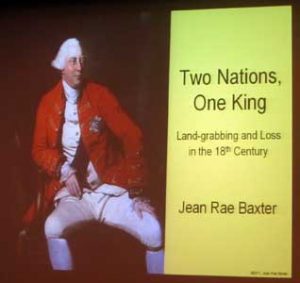 Jean titled her talk “Two Nations, One King: Land-grabbing and Loss in the 18th Century”. She outlined the relationship of native Americans to Queen Anne, who met four native “Kings” who were taken to England to meet her — 3 Mohawks, one Mohican. She had their portraits painted, and the paintings are now in Library and Archives Canada.
Queen Anne, a devout Protestant, was concerned for the spiritual welfare of the natives, and paid for the erection of a chapel at Fort Hunter (Scoharie) in 1711. The set of communion silver she sent to the natives was buried for safety during the Revolution. It was dug up during the war, and when brought to Canada, half was placed in the church at Deseronto and half at Brantford, Ontario.
Jean then outlined how two different groups of natives were treated by the British government. Those in the Southern Department, under commissioners John Stuart (not the Loyalist minister) and later Alexander Cameron, sold off land belonging to the native inhabitants to land speculators. The Henderson Purchase in 1775 was the largest private land purchase in the history of what became the United States: 20
million acres were sold by this agent of the Crown, for £2,000 and 6 wagonloads of trade goods paid to the Cherokees (who were later displaced from the southeastern states and forced to walk to Oklahoma Territory in the winter of 1838, a trek known as the “Trail of Tears”). Their leader Dragging Canoe was not strong enough to resist, and the Patriots felt they had supported the British too loyally during the Revolution.
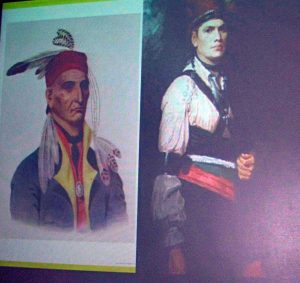 Dragging Canoe (left) and Joseph Brant
The Mohawks, meanwhile, fared better in the Northern Department under commissioner William Johnson, and their own strong leaders. White and native worlds merged at Johnson Hall, finding common ground in religion since many Mohawks converted to Christianity (vs. southern natives who did not). Although natives and their lands were not mentioned in the Treaty of Paris which ended the Revolutionary War, Joseph Brant formed a loose federation with other chiefs and was able to pressure the British government. The result was that Frederick Haldimand was directed to compensate the Mohawks for loss of their lands, as he was doing for white Loyalists.
You can read about this in more detail in Jean Rae Baxter’s second book set during the American Revolution, Broken Trail. For further details, see Jean’s web site www.jeanraebaxter.ca.