
Travels of Stephen Arnold and Families
(a talk by Bath Adams)
March 26, 2022
In many families, there is often an unofficially designated “Lineage Keeper,” sometimes one for each generation. You’ll know if it’s you! But for these folks, it seemed that the team approach worked best!
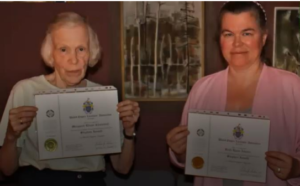 Beth has deeply fond memories of researching side by side with her mother, Margie (Margaret) CLEVELAND ADAMS, along with cousins in both those generations! Unlike some ‘proprietary’ families, this clan was incredibly collaborative! They gathered DNA results, scoured wills, deeds and land records and the ‘unsinkable’ Margie had a new stone installed at the base of an illegible one of their family ‘patriarch’ and wife, making the long-ago interred ancestors ‘spring’ into the consciousness of some ‘newly-found’ cousins.
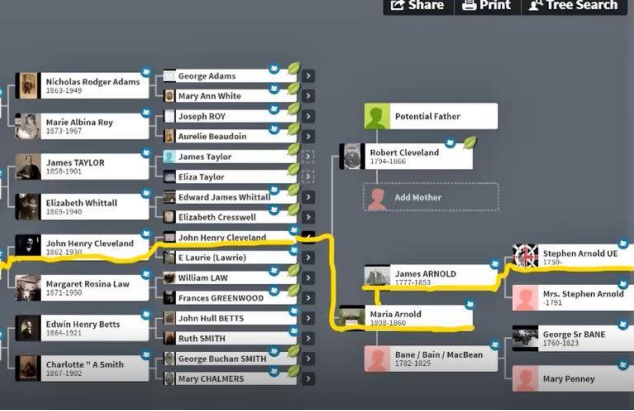
The early UE Loyalist strand to follow was Stephen ARNOLD, from Beth’s maternal family. Both he and his son James were granted land for their service to the crown. Having fled their home in New Jersey, they initially settled near Digby, Nova Scotia. Son James married Maria BAIN (BANE) in Digby at Holy Trinity Anglican in Nov. 1799. After the War of 1812, family members started moving to the shores of Lake Erie. Samuel, a son of James, received land there for his ‘youthful’ War of 1812 service. James and his daughter’s family followed in the early 1830’s. Thus, James started over twice travelling long distances both times.
With the name ARNOLD, one typical question is:” Are you related to Benedict? The surname CLEVELAND is also prominent, so the same question is posed for Grover Cleveland or Moses. And since both names are in Beth’s family, could they be connected to each other and to Beth’s family? So, Beth did her due diligence and took deep dives into these names, with the result that: ‘No connection is to be found.’ The tale goes that Benedict Arnold had a Loyalist family wife, Peggy Shippen, with expensive tastes and in his devotion to her, found himself in financial dire straights. Apparently, ‘turning his coat’ was lucrative to the tune of 20,000 pounds, and he subsequently led attacks, killing former neighbours after they surrendered. He died in 1801, but his reputation with both sides suffered, including in England and New Brunswick.
 Margie’s cousin, Uncle Chuck (another Charles), was also a story keeper. Chuck talked of a connection to the Loyalists, but who were they? By the end of Beth’s Grade Eight school year, history had come alive, and she had an introduction to the UELAC. And Uncle Chuck said being “UE” was a good thing. So, now what?
Margie’s birth surname was CLEVELAND, and she did a great deal of research trying to find the heritage of her ever-elusive ancestor Robert Cleveland (not found YET!) and in her declining years, as dementia gradually took her further and further ‘away,’ she was still very proud of her 2016 UE Certificate.
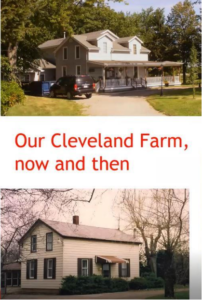
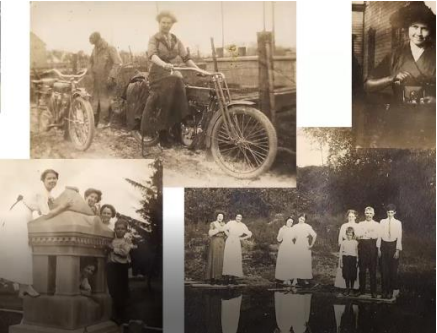 The parents of Margie and her sister Charlene were Charles Henry Cleveland b 1897 – d 1968 who married Elsie Marie Betts. They were rarely in photos together, but the ones taken while holding children and grandchildren show great warmth! And motorcycles! The fabulous Aunt Florence (Charles’ sister), who knew all the family history and shared it, had a ‘treasure-filled’ attic haven that Beth recalls enjoying on many visits with her cousins. Florence married Lloyd Crewe and had five children, many becoming Beth’s colleagues in research. Charles Henry’s father was John Henry Cleveland Junior. The families lived in the same community for ages, all with connections to the Cleveland farm. The old barn is now gone. The gravel pit is now a forest. Photos in the cemetery show spirited play on monuments. No rigid Victorian photos of this family! Photography, Bird watching, and Environmentalism continued in the family.
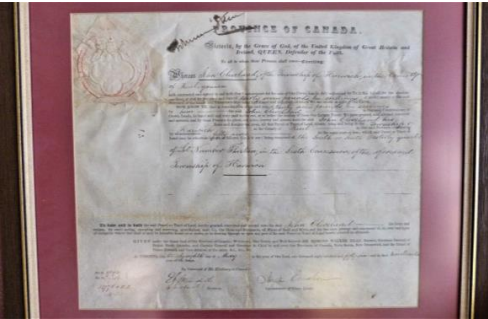 The framed Land Deed acknowledges the land granted to John Henry Cleveland Senior, of Harwich, Kent County in 1856 and it now hangs in Beth’s home. Beth’s father had a high regard for the pioneering family of his wife’s Cleveland family. John Henry Sr. married Euphemia LAURIE (LAWRIE) from the farm next door. They had come straight from Scotland. John Henry’s will of 1865 was found, with the help of the unique name Euphemia that makes her ‘easier’ to find! They and their ten children are all buried in Evergreen Cemetery between the two families’ farms.
To the south-west of the John Henry Cleveland farms, and of the town of Blenheim is Cedar Springs, a tiny hamlet with a Cleveland Street. In 1848, Robert Cleaveland Sr finally received his land deed granted for land there. Robert had tried to get his grant accepted twice.
When he finally got the deed, he was about 72, dying in 1866. His will divided his land between the two youngest children, since the older ones were already established. Oddly, John Henry was the only offspring with land east of Blenheim. Robert’s farm stayed in the family until 1980’s.
Robert Cleaveland Senior petitioned for land in Malahide Twp, Elgin County in 1831 from Col. Talbot. Some of you know of Colonel Thomas Talbot, b1771 Ireland – d1853 Port Talbot, London Region, Canada West. He founded Port Talbot and enticed approximately 50,000 settlers into the Thames River Area. https://en.wikipedia.org/wiki/Thomas_Talbot_(Upper_Canada)
The towns in that region ‘all’ had a Talbot Street, and well-made roads among other benefits. Sounds great, except if you had a religion other than “Church of England” on your documents. Those showing Methodist (John Henry Sr), or Baptist (Robert and Maria) were sometimes turned down as settlers. Talbot used pencil on his land maps, altering who was placed where, as he saw fit. His absolute, and ‘despotic’ rule over the area was part of the Upper Canada Family Compact ‘problem.’ Talbot had accumulated a vast number of acres of personal land, which were those awarded to him for every settler.
Records showed that Robert CLEAVELAND and Maria ARNOLD were married on February 23, 1822. After some ‘convincing’ by Margie, a Digby archivist provided a ‘limited access’ image showing that Robert and Maria had their first child baptised at Holy Trinity, Digby. It showed the birth of John Henry on 26 Feb 1822 and registration on Aug 31, 1822. The child was born 3 days after the wedding.?? And Maria was 14 yrs. old at the birth! Robert was 27. Their religion is shown as Baptist on many records, but the Feb 23,1822 marriage ceremony may have been a second one, and an Anglican one, since that was the only legal ceremony in Nova Scotia at the time. Similarly, ‘second’ weddings happened in the Upper Canada as well.
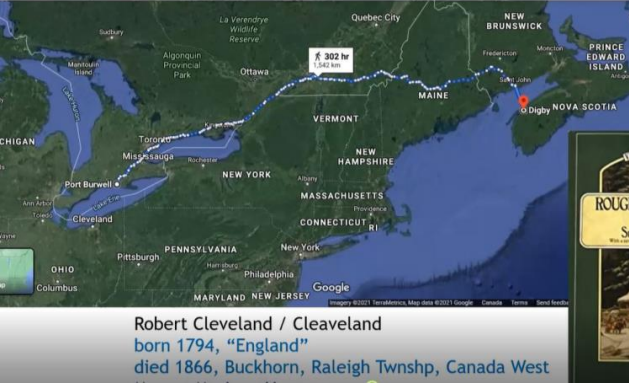 John Henry Cleaveland Sr’s parents Robert Cleaveland and Maria Arnold came to Upper Canada in the early 1830’s since one child, Phoebe, was born in Digby, then another in 1834 in Howard Township, Kent County. They travelled by boat, ship, and wagon on trails, there being no real roads. Robert’s occupation is shown as Mariner, Mason, and Yeoman in different locations and seasons. James Arnold, Maria’s father, was also a mariner. That may have been ‘how’ the couple met.
Several other children followed, and they moved together to Upper Canada. DNA matches help validate the connection, despite questions about her age and the ‘early’ birth. Robert and Maria are buried in a ‘hidden’ private cemetery outside Blenheim, with newly legible CLEAVELAND stone courtesy of Mom/Margie, making the information available. The records of the cemetery verify the dates that were found on other documents and the wearing-away details on the original stone that inspired the new one.
Another new connection was found, due to that new stone. A ‘new’ cousin and his family had been exploring in that cemetery and came across the stone, discovering the name spelled like theirs, and the stone was suddenly doing exactly as Margie had wanted: stirring the interest of others in the family. Later it was discovered that Beth’s grandmother, Mrs. Charles “Reata” Cleveland was the first teacher of ‘new-cousin’ Gary ‘Cleaveland’ in his Cedar Springs Schoolon land that Robert Cleaveland donated. Kismet or Karma?
James ARNOLD was Maria’s father; and her mother was Maria BAIN (BANE). James had owned and sailed a schooner in Nova Scotia called the Rising Sun. Their new home on Lake Erie, in Port Burwell, had a ship building industry, making it a familiar aspect. James’ brother Samuel ARNOLD, married to Barbara Bain, had previously moved there during the War of 1812, so having family already in the area, may have been another reason to move to that region.
Col Talbot encouraged maritime families to sell their rocky land claims and travel west to settle the Elgin -Thames River area. So numerous were the folks who arrived from the east, that the main street out of Port Burwell was called “Nova Scotia Line.” Many other family members followed the initial two Bain sisters and the Arnolds to Upper Canada. Descendants of the Bain family have spread along the Erie shore.
 James Arnold was buried in Port Burwell at Trinity Anglican that has a historic plaque. Samuel Arnold was in the ‘original’ 1812 New Brunswick Fencibles, later called the 104th Reg of Foot, which left Fredericton, marched for 53 days, 1176 km to Kingston, on foot in winter to aid in the 1812 defense along the St. Lawrence. Samuel obtained land on Nova Scotia Line, in Bayham Township near Port Burwell for his services. Cousin Heather Crewe did much of this research. The 2021 UELAC Conference featured a Loyalist of that same regiment, Prv John Baker who also made that same march.
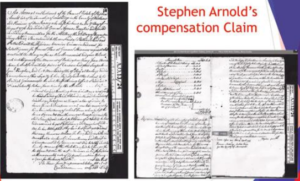 Stephen ARNOLD is the family proven UE ancestor. He was born in 1750 in Woodbridge, New Jersey and participated in two battles. The 1776 Battle of Long Island, and The Forage War of 1777. His Loyalist claim indicated that he left land behind in New Jersey; likely was a ‘scout / spy’ for the British; and ran boats to land the Hessians from the seagoing ships to Long Island. His son was most likely born in Fairfield, Connecticut, circa 1777 and it seems that Stephen and “Mrs.” Arnold were likely in that area until 1783. As per his losses Claim, he “missed the boat” in the 1783 Loyalist evacuation but still got to Digby, handing in his land claim late. It seemed odd that a Seaman would miss a launch time. Samuel’s birth in 1784 in Digby proves that they did get there, somehow. Stephen was granted lands and a land transfer record shows the land went to his son James. The Arnolds home and farms are gone, but old maps showed their location with stunning views.
In about 2005, Beth travelled with her mother to the area. The Admiral Digby Museum was locked, despite them having called ahead, so they went to the office next door to get advice. There they met the staff of the now well-known UE author and historian Brian McConnell, Lawyer. The map in Brian’s reception room was better than the museum’s map at that time.
The father of the ‘Bain’ sisters, George Bain, also UE, had land by a ‘former’ lighthouse site, a busy noisy place, with poor soil. Hence, the Bains moved to ‘Broad Cove’ later named Culloden, but it was also not well suited to farming, so they made his living in the lumber trade and from the sea, as did son-in-law, James Arnold.
During this research, Beth met Irma Walker, whose book draws an excellent picture of Digby at this time. A Culloden Chronicle explains many of the difficulties with original grants for Stephen, James, and Samuel Arnold and others who were finally granted land in 1801. James’ wife, Maria Bain, died in 1825, and both are buried at Holy Trinity in Digby, as are two of Robert and Maria’s children. Stephen Arnold Sr (1791) and his wives are buried in Digby also. In 1813, Stephen Jr was still in Digby, but no final resting place for him is known.
Beth has thoroughly enjoyed her very collaborative adventures, with her mom, Margie Cleveland, her Crewe cousins, Mike Cleaveland of PEI, and Gary Cleaveland whose children discovered the ‘new’ stone.’
We hope you enjoyed this story.
Q and A:
- Beth and her colleagues in research used onsite in-person and digital land records and land transfer documents containing relationship details. https://www.onland.ca/ui/ (Jane MacNamara taught courses in using the onland.ca/ui/ website for the Toronto Branch of the Ontario Genealogical Society. It is sold-out for April 2022, but she will be presenting at the O.G.S. Conference in June as well.)
- They were also able to use the excellent online resources from Elgin County OGS.
- Although Robert’s census records say “England’ as his birth location, there is no other information about his heritage. DNA tests have not helped.
- Access to the Digby records was through the Anglican Diocese archives in Halifax.
- As far as Baptist records go, there are very few very old ones for Nova Scotia. Unlike other major unified churches, the Baptist churches have no overseeing body. The churches may have had records, but they usually do not exist now for Baptist churches.
- Some “Convention Baptist records are at McMaster University
- Marilyn Adams Genealogical Research Centre in Ameliasburg (Also called The 7th Town Centre) has Land Books for Hastings and other nearby areas. Kingston area ones went to Queen’s U then to Lennox and Addington Archives at Napanee. Seeing the books in person is amazing and much better than the often-poor images online.