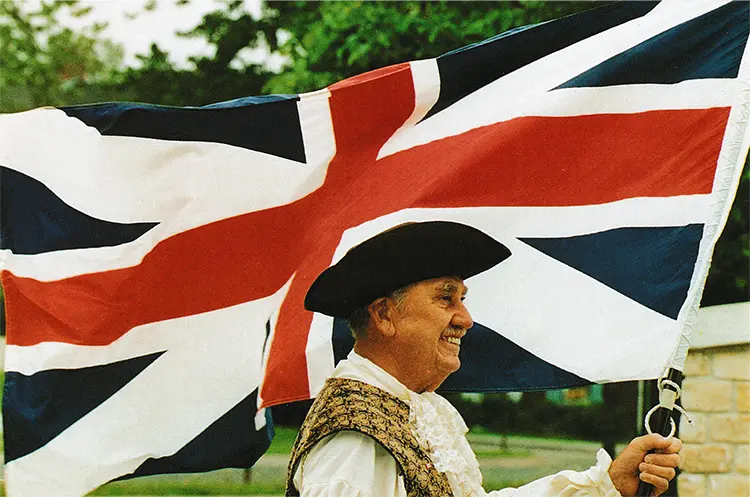

St. Alban the Martyr United Empire Loyalist Memorial Church in Adolphustown
(a talk by Diane Berlet)
January 23, 2021
 We were privileged to see an excellent presentation about St. Alban the Martyr United Empire Loyalist Memorial Church in Adolphustown. Diane Berlet, historian of the former church, told of how the arrival of Loyalists in Adolphustown was behind the building of the church, and how a continuing tribute is paid to the Loyalists through the memorial tiles adorning the interior of the church. Axel Thesberg, Chair of Friends of St. Alban’s, spoke about future plans.
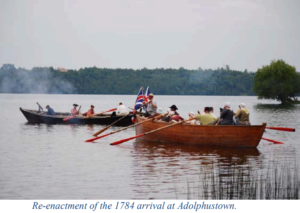
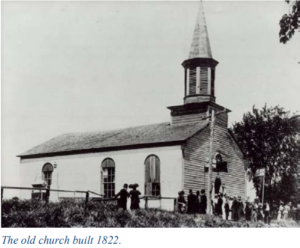 Diane reminded us that the Loyalists first arrived at Adolphustown in 1784 after wintering near Sorel, Quebec. They were quickly assigned plots of land, although many never settled on them, choosing instead to trade or sell them. Those who did settle around the growing village of Adolphustown did eventually build a frame church as a place of worship.
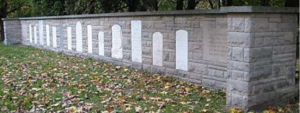 This is a wall in the old burying ground at the landing site. It is said that the land for a cemetery was set aside on the day of arrival as a baby had died on the journey. There are many unmarked graves where perhaps wooden crosses once stood. Surviving stones were placed in the wall when the cemetery was restored in 1955 by the Toronto Branch of the UELAC. There is a UEL Research Centre and Museum near the Landing Site (in the former home of Loyalist David Allison) and a campsite and park maintained by Quinte Branch UELAC.
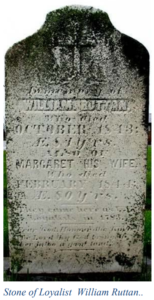 There was also a cemetery established around the first wooden Anglican church and there are gravesites of some of the original landing party, such as the stone (shown at left) marking the resting place of William Ruttan, which was recently restored by the Quinte Branch of the UEL. A commission has been set up to identify gravesites of War of 1812 participants: thus far three have been identified in the St. Alban’s cemetery and will be marked at a special ceremony in June, 2021.
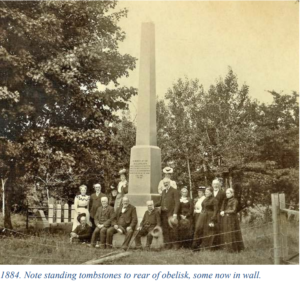
In 1884, there was a three-day celebration of the Centennial of the arrival of the Loyalists. Visitors from all over descended on Adolphustown for various festivities including the dedication of an obelisk in the park near where the above wall can now be found. However, the new rector of St. Alban’s, Rev. Richard Sykes Forneri, felt that an obelisk was not nearly enough, and he embarked on plans and fundraising for a new stone church.
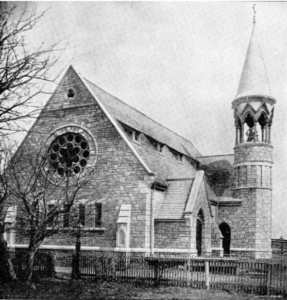
 Rev. Forneri hired Joseph Powers, the foremost architect in Kingston, and secured a plan for a mini Neo Gothic Cathedral that costed out at $5,000, a great deal of money at the time. His vision must have seemed unrealistic to his small group of parishioners, just 20 families. Rev. Forneri set out on a year-long, province-wide quest to raise pledges for the required funds, which turned out in the end to be $8,000.
He appealed to Loyalist descendants, travelling to preach in Toronto, Niagara, Hamilton, Ottawa and even Montreal. Miraculously he achieved his goal and the cornerstone of the new St. Alban the Martyr United Empire Loyalist Memorial Church was laid June 17, 1884 by then Lieutenant Governor, John Beverly Robinson. John Beverly’s UEL ancestor, Christopher Robinson is featured in a memorial tile in the church, the only green tile amongst the blue and beige.
 In his travels Rev. Forneri promoted the idea of a United Empire Loyalist Memorial Church by seeking sponsorship for memorial tiles to be mounted in the church, paid for by the descendants of Loyalists to honor their ancestor. A tile cost $7 or $14, depending on colour. You could provide the wording you’d like to see on it, although surviving order forms illustrate the fact that wording was edited for brevity.
The order was then sent off to the Minton pottery works in Stoke-onTrent, England, where the tile would be manufactured. The architectural plan called for 64 tiles but the orders only trickled in and it was to take 25 years before the envisioned tile frieze was completed.
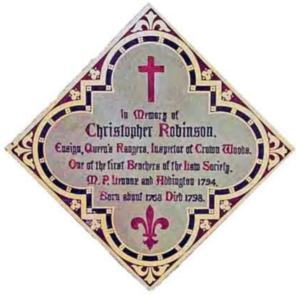 Diane pointed out these are not handpainted tiles, as many have thought. Rather, they are encaustic: meaning that the designs and lettering were all carefully inset by hand before the tiles were fired. This is a rare technique, developed by Herbert Minton in the 1850s based on his study of 13th century tiles at Westminster Abbey. The only other major location of encaustic tiles in North America is the lobby and hallways of the U.S. Capitol Building in Washington, DC.
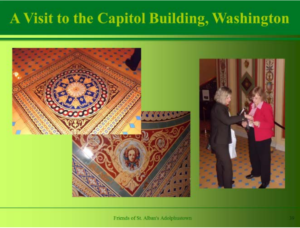 A few years ago Diane Berlet presented the building’s curator with a copy of her book about the tiles. The curator was most interested in hearing more about the manufacture of the encaustic tiles at the Minton pottery works, which were produced for a period of only 50 years in the latter half of the 1800s.
Not all Loyalists commemorated were local, nor were all Anglicans. Rev. John Bethune was the founder of the first Presbyterian church west of Quebec and also grandfather of Dr. Norman Bethune, noted Canadian surgeon.
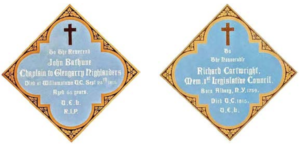 Richard Cartwright was a very successful entrepreneur in the Kingston area. Later a judge and a politician in Upper Canada, he was married to Magdalen Secord, whose sister-in-law was Laura Ingersoll Secord.
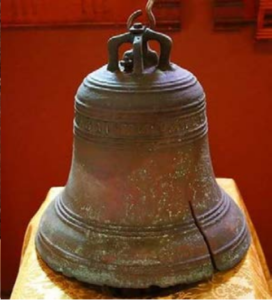
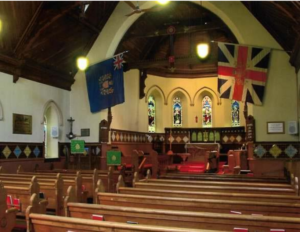
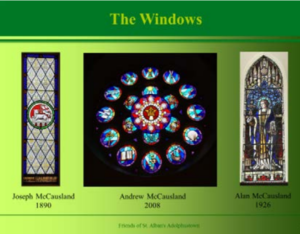 Other notable architectural features of St. Alban’s include outstanding stained glass windows installed over a period of 130 years, and a tower designed to hold a bell that never hung in this church but was cast in Bristol, England in 1690 and gifted to the original church. The unique hand-crafted wooden ceiling may well have been constructed by local boat-builders. All these make it a wonderful building. However, the congregation dwindled and in 2018 it was closed.
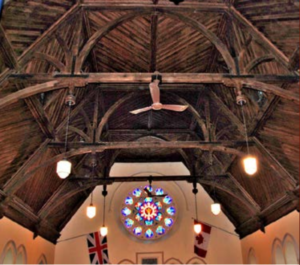 The Friends of St. Alban’s group are now planning to purchase the building and rectory, and are planning for its future use as a museum and a community meeting place to serve the arts, social events, whoever would want to use this magnificent space. They are fund-raising for funds to restore the tower and perform other work. Their Strategic Plan outlines plans for 2021
  and beyond. You can be kept apprised of their progress and of other news and events by subscribing to their mailing list or by following the Facebook page. To become a member of Friends of St. Alban’s Adolphustown or to order the richly illustrated book The Loyalist Tiles of St. Alban’s, please contact info@friendsofstalbans.ca.
At the end of the meeting, after Program Chair Jean Rae Baxter thanked the speakers, Treasurer Nancy Cutway displayed a cheque for the donation to Friends of St. Alban’s Adolphustown approved by the branch executive at its last meeting for $500. We encourage individual members to follow suit, as they are able.