
O’Reilly Folklore
(by Miles O’Reilly)
November 2020
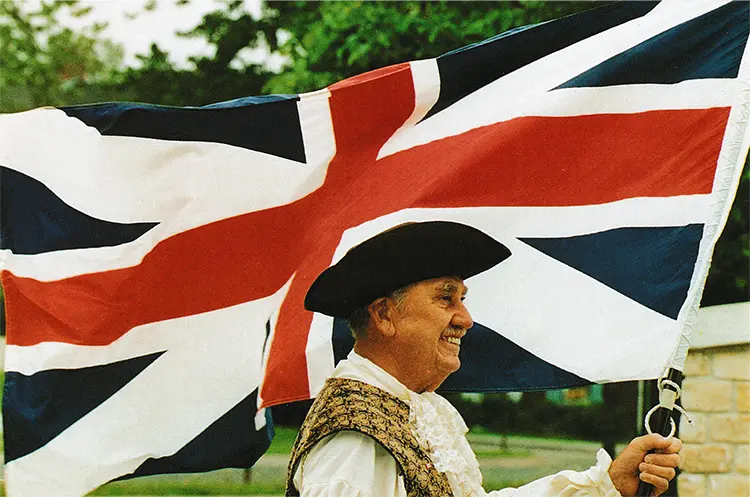
The family folklore has it that John O'Reilly Sr. had been a Jacobite in Ireland and after the defeat of Bonnie Prince Charlie in 1745, he decided to leave and start a fresh life in North America. Accordingly, he pulled up stakes and sailed for Baltimore where he settled and established a school. To start afresh, he gave up Roman Catholicism, and joined the Church of England, gave up the Jacobite Pretenders, and endorsed the King of England. He was successful, married, and had his first of many children in December, 1749, John O'Reilly, Jr. in Baltimore.
The school prospered and eventually was taken over by the University of Pennsylvania, in Philadelphia. In the next twenty-five years, rumblings were going on between the settlers and the English home country. Once things got hotter after the Declaration of Independence in 1776, people were having to make a decision of what further steps would be taken, and take sides.
There was no easy decision to be made. Once the shooting started, the entire country was divided between the Patriots who wanted total independence to form a new country, and the Loyalists who wanted to find a way to settle their complaints with the Crown. A full out war ensued and battles swung back and forth, with thousands killed on both sides. England was also at war in Europe and could not divert all its troops to North America. The supply lines were stretched thinly and it was getting to be too much to fight two wars. In 1783 the Treaty of Paris was signed creating the United States.
The Patriots had also suffered greatly and they took it out on the Loyalists. John O'Reilly Sr. then decided to give up the school and head north to British North America where he and his family settled in Upper Canada. It was said that several years later, a delegation from Philadelphia came up and tried to persuade him to return and resume his position with the University. However, he was now getting much older and could not be sure that all enmity had been assuaged against the Loyalists yet. His son, John Jr. would later become a Sergeant in Butler's Rangers together with several of his brothers, and received land in Stamford Township, Lincoln County, Niagara District.
************************
My father, Miles Breffni O'Reilly, had never been to Ireland. In fact, he had never been across the Atlantic. However, when I told him that I would be taking a year off upon final graduation in 1960 in order to go backpacking in Europe, he said that I must visit Cavan Town in County Cavan in Ireland, the seat of the O'Reillys. He had also heard that somewhere nearby there was a monument to one Myles the Slasher O'Reilly, so look out for that.
Cavan is located as the southernmost County in the Province of Ulster in the north of Ireland. Consequently, I found myself standing, backpack on my back, on the road approaching Cavan Town on a spring day in April, 1961. Birds singing, rhododendrons blooming. As I strolled into the town, on either side of the street were commercial establishments: O'Reilly's Green Grocer, O'Reilly's Public House, O'Reilly's Bakery, O'Reilly's Hotel; in Toronto, the closest we could come to the name commercially was a locksmith, who had dropped the O' from his surname.
After spending the night in O'Reilly's Hotel, I got instructions to find the memorial for Lord Miles O'Reilly which lay a short distance south of Town in a village called Finea [pron. Fin- ay].
Sure enough, there in the centre of the Village of Finea, next to the River Inny stood the monument:
MYLES O'REILLY,
WHO FELL ON THE 5TH DAY OF AUGUST, 1646
WHILE DEFENDING THE BRIDGE OF FINEA
AGAINST THE ENGLISH SCOTTISH FORCES UNDER
GENERAL MONROE
"HE FOUGHT TILL THE RED LINES BEFORE HIM,
HEAPED HIGH AS THE BATTLEMENT LAY.|
HE FELL BUT THE FOOT OF A FOEMAN
PRESSED NOT ON THE BRIDGE OF FINEA"
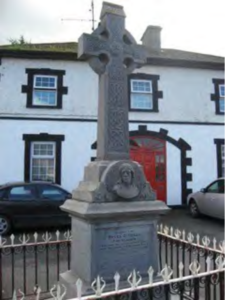
The details of the gory story are carved into the reverse of the memorial:
THE SLASHER HAD WITH HIM 100 HORSE, WHILE THE
ENEMY WERE 1000 STRONG. HE FOUGHT THEM THE
WHOLE DAY LONG, TILL HIS FOLLOWERS WERE NEARLY
ALL SLAIN. FINALLY HE WAS ENCOUNTERED BY A
GIGANTIC SCOTSMAN WHO THRUST THE POINT OF HIS
SWORD THROUGH THE SLASHER’S CHEEK, THE LATTER
CLOSED HIS JAWS ON THE BLADE AND HELD IT AS IF
IN AN IRON VICE WHILE HE SLEW HIS ANTAGONIST
CUTTING HIM THROUGH STEEL HELMET DOWN TO HIS
CHIN WITH ONE BLOW, BOTH FALLING TOGETHER.
AT THAT MOMENT REINFORCEMENTS ARRIVED
FROM GRANARD AND THE BRIDGE WAS SAVED.
 From this memorial you might have thought that the Slasher died at the Bridge of Finea. However that was not his end. He recovered and lived in Cavan to the ripe old age of 54!
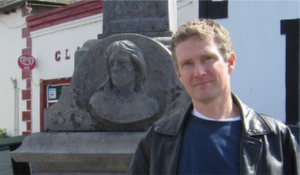
[photo above: Miles’ son at the memorial to Slasher O’Reilly]
Having grown up with little knowledge of Irish history, I was curious to learn about the warfare that was going on at that time. What follows is a brief summary of relations between Ireland and England during the last 500 years that might have contributed to emigration from Ireland, apart from famine.
12th Century
The island of Ireland had been taken over by medieval English and Anglo-Norman settlers, divided between Old or Gaelic Irish and Old English. Politically, the land was divided locally amongst individual Irish Lords: the Counties around Dublin were known as the Pale and administered by the English, under English laws and language. As a result, the Hiberno-Norman Lords were able to carve out their own fiefdoms in the remaining Counties with a high degree of independence, and under the Roman Catholic religion.
16th Century
The Tudors were technically in control of Ireland, but they principally did not want the cost of such control, except for preserving the interests of the English settlers in the Pale. Consequently, they delegated government to one of the stronger Hiberno-Norman dynasties, the FitzGeralds of Kildare, to keep down the cost of running Ireland and to protect the Pale. By 1534, Henry VIII had passed a law making him also King of Ireland. He discovered that “Silken Thomas” FitzGerald was plotting with others to depose him; he seized them all and had them beheaded. In order to impose control, Henry required all of the Lords outside of the Pale surrender their Irish titles and then re-granted them new English titles. If they had not signed by a certain date, they would be outlawed! Cavan was the last county to sign on.
1569 to the 20th Century
During this period many rebellions broke out and were put down by English and Scottish forces, including the Nine Years’ War under Elizabeth I, 1593-1603, the Confederate Wars (the Eleven Years’ War) under Oliver Cromwell 1641-1652, the “Glorious Revolution” 1688-91 under William III, the Irish rebellions of 1798 and 1803, the Easter Rising 1916 and the Troubles, 1969-1998.
The Four Horsemen of the Apocalypse have been trampling through Ireland for a millennium: Conquest, War, Famine and Death. My UEL ancestor John O’Reilly, and his ancestors experienced them all. It was probably not any one thing that made him think that there might be a better place to live in this world to make a living and raise a family. He had been born in Baltrana in County Cavan in 1725, and was an educated, intelligent, faithful Roman Catholic. It is likely he was a Jacobite, and may have been one of the Wild Geese that fought at Culloden in 1746. It was certainly shortly after that date that he decided to leave County Cavan and cross the Atlantic, a dangerous venture at the best of times.
What is known is that he first settled in America in Baltimore where his first son, John, was born on December 3, 1749. He established a school and started a family. Wanting a complete change, he swore allegiance to the King of England and joined the Church of England. His school was doing very well, and at some point he was invited to join the University of Pennsylvania, in Philadelphia. But there were rumblings.
The Americans had many complaints about England, principally about taxation and representation in government and regulation of the colony’s commercial dealing with other countries. This ultimately led to confrontations that escalated to armed interventions, culminating in the Declaration of Independence in 1776. For the next five years, fighting continued between the Patriots, the British and the Loyalists, each trading victories and losses, until the British Army surrendered at Yorktown, Virginia, in October 1781.
Animosities ran high between the Loyalists and Patriots, as is common in civil wars. Therefore, it is no surprise that a goodly number of Loyalists left, taking what they could carry and resettled in different parts of British North America. Although the Treaty of Paris in 1783 formally put an end to the Revolutionary War and established the Thirteen Colonies as a Republic, animosities to the Loyalists persisted. Therefore, in 1786, John took his family (11 children!) to Upper Canada and settled in Stamford in the Niagara Frontier. A few years later, when a delegation from Philadelphia came up to ask him to return he admitted that he was too old to start over and his now large family was well established in Upper Canada.
John Sr. died in 1812. Five of his sons served in the war of 1812 in Butler’s Rangers.
Editor’s Note: You may think that Butler’s Rangers were only a Revolutionary War unit. However, Col. John Butler settled in the Niagara Peninsula area, as did most of the men of Butler’s Rangers. He served there as deputy superintendent of the Indian Department until his death in 1796. Wikipedia notes, “Although advanced in age, many of Butler’s Rangers lived to fight in the War of 1812, which they did with the same spirit which had distinguished them in the Revolutionary War.”