
Three Loyalist Heroes
(a talk by Ruth Nicholson)
November 24, 2018
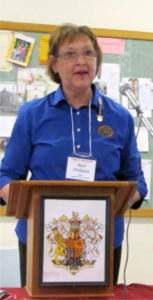 Ruth Nicholson spoke to us about “Three Loyalist Heroes”. Ruth’s definition of a “hero” is someone “who puts him or herself ‘out there’ for a controversial stand, a warrior or a soldier fighting for a cause,” a courier performing undercover work in the name of protecting a great truth, and a politician being on the ground floor of creating a new nation. “This is what I see when examining the lives and actions of Robert Land, Isaac Ferriss and John Cornwall.”
Robert Land is an important figure in the early settlement of Hamilton, Ontario. During the Revolutionary War he served as a courier for Colonel Clinton as well as recruiting for the Crown. He was captured once but managed to escape. He made his way to Niagara, by which time he believed his family had been killed, since he had seen the remains of his house which had been burned down by Patriot Rebels. Three years later he moved to Barton Township. Meanwhile his wife and children had escaped to New York and then were granted land in New Brunswick. In 1791 they relocated to Upper Canada, heard that a man named Land was living at the head of Lake Ontario, and were reunited with Robert. He and his sons eventually owned 1,000 acres of land that now forms part of downtown Hamilton.
Ruth told us that in April 2010 the Hamilton Branch of the UELAC raised a plaque in Hamilton Cemetery and had a ceremony at the Land family crypt. Over 100 people attended this ceremony. Ruth quoted the Honourable Sophia Aggelonitis, then Minister of Consumer Affairs, as saying “There is surely no more remarkable story in Hamilton’s history than that of Robert Land, the English lad who became a settler, magistrate, farmer, soldier and spy, a Loyalist who lost everything, both family and home and regained his family in this place overlooking the waters of Burlington Bay.”
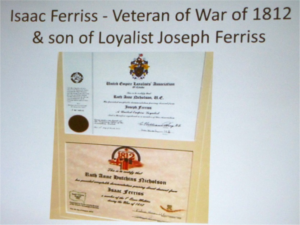 Ruth showed her Loyalist certificate through Joseph Ferriss UEL and her War of 1812 certificate based on Isaac Ferriss’s service. The former certificate was of course obtained from UELAC, and the latter was obtained from the Ontario Genealogical Society.
Ruth’s next hero was one of her ancestors: Isaac Ferriss, eldest son of Joseph Ferriss, a Loyalist ancestor on her maternal side. Isaac enlisted in the 1st Essex Company of Volunteers at age 17 when the War of 1812 broke out and prepared to defend Fort Amherstburg and Fort Detroit. He and another man volunteered to swim across the Detroit River to surround any American spies on Bois Blanc Island. For this courageous action he was eventually awarded a Military General Service Medal when they were commissioned by Queen Victoria in 1847 for those surviving claimants involved in one of the three most notable victories for the British: Battle of Fort Detroit, Battle of Chrysler Farms and Battle of Chateauguay. Ruth was able to show us photos of both sides of the medal, which remains in family hands.
Ruth’s third hero, John Cornwall UEL, is her 6th-great paternal grandfather. In 1776, on his way to New York to enlist in one of the King’s regiments, he was captured by Rebels and thrown into a prison at Esopus, in one of the floating jail ships, for five months. He then escaped and made his way to Albany to join Butler’s Rangers. At the end of the war he received land close to Amherstburg. He too had been separated from his wife and children, who were driven from their home in Connecticut to live with his wife Mary’s sister in a nearby county until the end of the war. The family joined John in 1797, after an astounding separation of twenty-one years. John Cornwall was a politician as well as a farmer, elected as the legislative representative of Suffolk and Essex Counties in 1797, at John Graves Simcoe’s second parliament of Upper Canada (1797-1800). His son Joshua and grandson Nathan also served in the parliament of Upper Canada.
Ruth said in conclusion that these three men — Robert Land, Isaac Ferriss and John Cornwall — were heroes in a variety of ways, acting as a spy, a recruiter, a soldier, an escapee, a refugee and a parliamentarian. In all ways, these early residents of Upper Canada and their families helped to shape the country that we live in today.