
The Young Estate: A Proud History in Prince Edward County, since 1783
(provided by Barbara Carson)
March 2016
In 1783, Colonel Henry Young, the very first United Empire Loyalist, settled in the County at The Young Estate. Young, born in 1737, was from Nottingham England, and came to America at an early age. He joined the British army and served for six years until the close of the Revolutionary War early in 1783. He retired from the army at half-pay with a grant of 3,000 acres of land stretching from Sandbanks Provincial Park to the East end of East lake. In 1783, he and Lieut. McCarty went out in a canoe came up the St. Lawrence River and the Bay of Quinte and entered Picton Bay. From the Bay, an Indian trail to East Lake took them on their exploration of the county. They left their canoes and crossed Hallowell and Athol townships exploring East and West Lakes. That year he claimed the north shore of East Lake and around the lake head down to what is now known as lots 4, 5 and 6 on the south side of East Lake.
The first United Empire Loyalist to settle in The County
Pleased with the location of this property, Col. Young returned in the fall of that year with two sons Daniel and Henry to claim a grant of this land along the shore of East Lake. He left his two sons on East Lake late that year and returned with four of his daughters the following spring. At this time the land was densely forested and water was the highway. Land was slowly being cleared to create fields for farming. Trees were cut and the stumps were burned and in some cases removed and used to create fences. As the fields were created wheat was then planted. Flour mills sprang up on the fast flowing streams as the wheat market grew in demand.
Daniel and Henry Jr. start work on the property
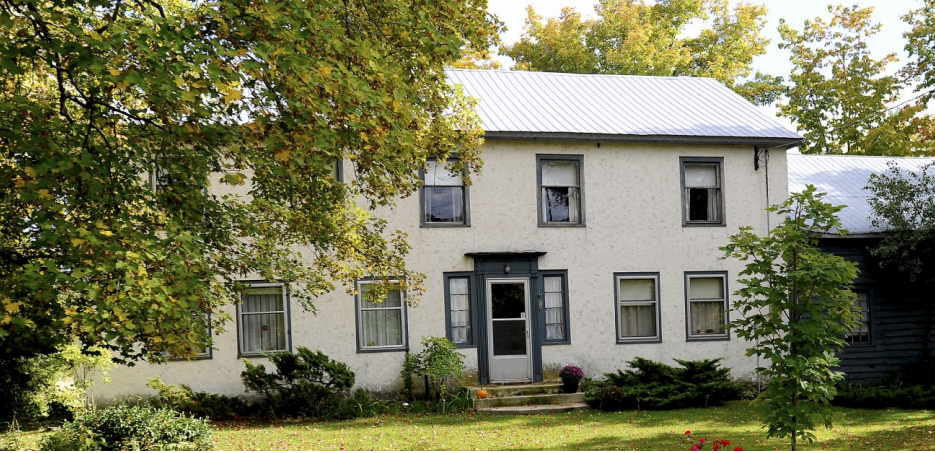
Col. Young’s sons, Daniel and Henry Jr., spent the winter of 1783 on this property alone as he returned to gather up his family at St. John’s on the Richelieu. Daniel and Henry Jr. built a cabin that is now the west extension of this house, for the arrival of their father and four sisters in the spring of 1784. There is controversy as to whether their mother Maria came with them to East Lake or returned to her Dutch family at Hoosick, New York who seemed to have leaned to the American side. She died in New York in 1808. It appears Maria did move to the property to join her children and husband after the house was built. Col. Henry died at this house in 1820 having acquired the three thousand acres around this property, including all of Sandbanks Provincial Park. His family married into several other U.E. families and began a rich pattern of settlement in their chosen place.
A summer full of uncertainty
The summer of 1780 was full of uncertainty and worry for Maria Young and her children on their farm in the Hoosick Valley of New York State. Maria’s husband Henry had left in 1776 to join the British forces and it had been a heavy burden for her to operate the farm and raise seven children.
Mary and Henry had lived on the farm from the day they married in 1760. It was land they had leased from the patroon Stephen Van Renssellaer and they had prospered over the years. However, the war had changed everything. Now, an act had been passed by the New York Legislature in the summer of 1780, requiring justices of the area to notify the wives of all persons having joined the enemy (the British) that they must leave the State in twenty days. If they remained after that “they would be liable to be proceeded against as enemies of the state.”
On Sept. 20, 1780, the Board of Commissions for Hoosick warned several women to depart the State taking only what they could carry and children under twelve. Among these women was Maria Young. She immediately made a special request to remain at her habitation but after consideration, the Board denied her request. Maria then sought the protection of her father and was allowed to stay until 1783.
By now, many people who had remained loyal to Britain, had been driven from their homes, had their property confiscated and their houses and barns burned. Some were even jailed and tortured. Animals were seized and driven away.