
Accessing and Preserving Family Heirlooms
(A talk by Adriane VanSeggelen)
December 2, 2017
 Archives of Ontario Conservator Adriane VanSeggelen spoke on “Accessing and Preserving Family Heirlooms”.
Adriane’s talk was very interesting and informative, but a little scary for those of us who are still storing old family photos in shoeboxes in the basement, or old grocery store cartons in the garage … but now we know what NOT to do, and how to remedy these situations which could lead to the irreversible degeneration of photographs and paper documents.
Adriane defined Preservation as “actions taken to prevent damage through use of safe storage methods”. She discussed ideal environments and containers (18-20 ̊C, 50% humidity) as well as handling and display methods.
First, we need to remove paper clips and staples from documents we want to keep forever.
Printer paper is acid-free, so it can be safely used as a divider between documents; or fold a sheet to enclose a document.
Pest management is very important. Avoid them to begin with by controlling dampness. Use new supplies (e.g. don’t use grocery boxes that may have had pests travelling with foodstuffs). Inspect items for pests. The most common and destructive are carpet beetles (wool, leather); silverfish (love paper and the gelatin layer on photos); clothing moths (larva are very small but sparkly); and cockroaches (eat paper and old books, but require professionals to deal with them if present).
If you find something is infested with a pest, wrap the item in clean tissue or unprinted newsprint and put it into a freezer bag. Then put in a deep freeze (not just a refrigerator freezer) for two weeks to kill the eggs. Remove the item from the freezer but leave it in the plastic bag for 2-3 days so it gradually warms to room temperature and humidity, then open the package and examine the document carefully. (Note: this is the only place where Adriane said it would be acceptable to use newsprint, just as a wrapper when an item is being frozen. Beyond that, newsprint is too acidic to put into contact with anything you want to keep.)
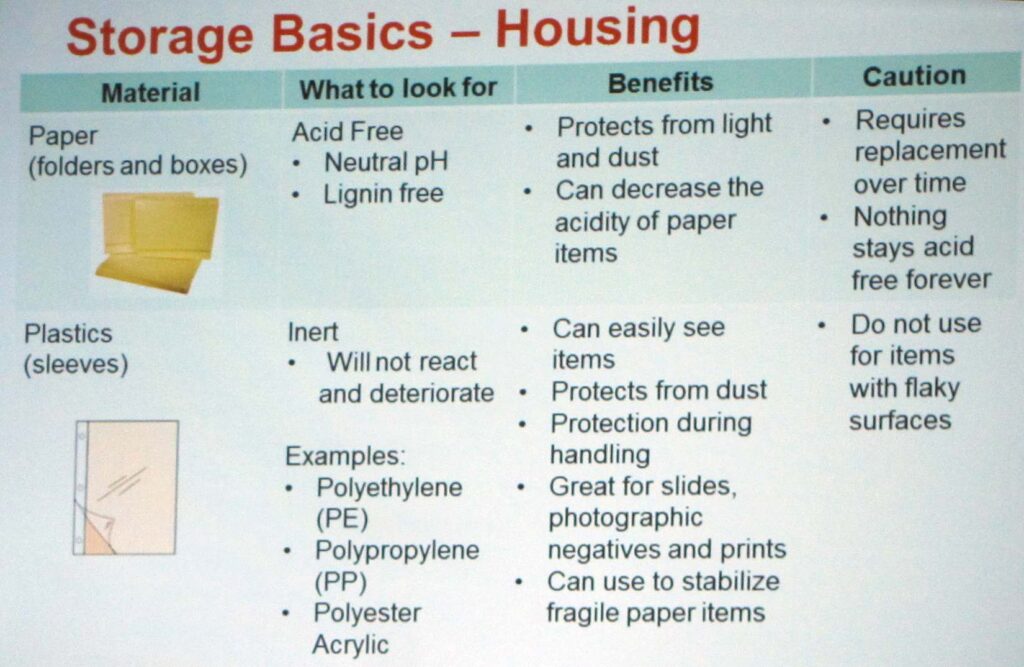
Adriane mentioned that even acid-free folders have a 20-year lifespan and should then be replaced, because they absorb acid from the items inside them. The main reason for using them is to provide support for fragile paper.
Plastic sleeves and containers MUST be PVC-free. Polyethylene, polypropylene and polyester acrylic are fine, and most acid-free holders are so marked when you purchase them. Even Staples sells acid-free sleeves. Adriane also mentioned uline.ca has a good range of supplies, particularly acid-free file folders. For acid-free storage boxes of various sizes, Carr-Maclean is your best bet. Anything with a PAT designation is the top-most quality, but as long as it’s acid-free, it’s acceptable.
Any photographs presently in “magnetic” albums, PVC sleeves or glassine envelopes should IMMEDIATELY be rescued. (Glassine envelopes are okay for negatives, as there is no gel to stick to the envelope.) To remove photos from the “magnetic” albums, Adriane told us to use dental floss; gently and slowly slide a length of it underneath the photo to loosen it from the sticky page. If this does not work, then scan and digitize the photo before it deteriorates further: glue from the sticky page below and the plastic cover above are both working to degrade the photo.
Do not attempt to unroll curled photos yourself, particularly something like a large panoramic photo. Such items need professional intervention by a conservator or else they’ll crack. Photos can be marked for identification on the back with a soft pencil, near the edge – 2B pencils are ideal.
To glove or not to glove? Adriane urged us to use gloves when handling photo negatives, prints, or anything metal: and of course to handle items only from the edge. Gloves can be cotton (can wash and re-use) or nitrile or vinyl (disposable). Gloves are generally not recommended for using paper, in spite of what we see on TV shows such as “Who Do You Think You Are?”
Gloves may damage fragile corners of pages. If you need help to turn a page over, insert a sheet of printer paper under it as well as over it and then flip carefully. Paper items should ALWAYS be supported when moving them and, to our surprise,
Adriane spoke about handling paper by the centre, using spread-out fingers underneath, instead of pinching a corner between two fingers.
Gloves can be worn while handling paper if it is preferred, but clean dry hands are imperative if gloves aren’t going to be worn. That means freshly washed and dried hands. And if you touch your face or hair, your hands need to be re-washed before continuing. Unwashed hands (the oils, not just physical dirt) are very problematic, so emphasizing the clean and dry part is key.
Books should be supported on a pillow – after you do a “karate chop” down the middle of the pillow, to create a channel that the spine can rest into. Make a paper wrapping (again, acid-free paper must be used) for dirty books or books with red rot of the leather (you’ll see a fine dust on the cover and binding). If a book has loose covers, buy cotton twill tape from a fabric store to wrap it and hold the covers on. Make sure to tie the bow at the side, top or bottom so it sits inside the recess made by the pages inside the covers.
If you want to frame and display a family photo or document, Adriane stressed that you should keep the ORIGINAL stored safely away, out of the light; display only a reproduction. The photos they have hanging around the Archives of Ontario are all copies, which can be re-created and re-hung when they fade.
A final rule: NO TAPE, ELASTICS, STAPLES OR LAMINATION. Period.
Adriane suggested that questions can be addressed to reference@ontario.ca but she was also gracious enough to answer several questions from the audience. When asked if photos should be removed from old photo albums, she said that while the black paper was not the best, context trumps preservation: it is important to preserve the context of which photos great-grandmother put side-by-side and on subsequent pages. She recommended scanning and digitizing each page, then putting the photo album into an acid-free storage box away from light and handling. The same would be true of scrapbooks where items are glued onto the rough paper they generally were made from. Keep the original dark, cool and dry.
If 35-mm slides have developed a vinegary smell, put them in a freezer. They are likely made of cellulose acetate and are degenerating. (Better if polyester.) Again, digitizing them soon is the recommendation.
When digitizing material, do NOT store on CD-ROMs (they deteriorate fairly quickly) or on flash drives; use an actual hard drive with platters, whether mounted in your computer or externally. Another copy in “cloud storage” (Dropbox, iCloud, etc.) is a great idea in case the hard drive fails.
You can get acid-free photo storage boxes from Michael’s craft stores, as well as things like acid-free photo corners. You can also buy (probably from a supplier like uline.ca) ziplock bags that are polyester and are acceptable; don’t use plastic grocery bags to store anything. And in response to a final question, Adriane said that acid-free boxes make better outer storage containers than Rubbermaid® or other plastic tubs, because the boxes breathe.
Google any of these suppliers to find their website. Visit the CAPC-ACRP.ca site to ask about certified conservators in your area of Canada.
In Kingston, if you need conservation done on a special family heirloom, Adriane pointed out that Queen’s has a Masters of Art Conservation program; perhaps its students take on projects.