
How Thousands of Loyalists Were Shipped to Eastern Ontario
and how such maritime industry shaped the development of Central Canada
(a talk by David More)
May 30, 2017
Our speaker was David More, a PhD candidate in history at Queen’s University. He spoke about “How Thousands of Loyalists Were Shipped to Eastern Ontario and how such maritime industry shaped the development of Central Canada.”
Thanks to Mr. More, we learned a lot about how the Loyalists arrived here. Most of us had probably not given much thought to Loyalist travel arrangements. They came by ship to Montreal; they spent the winter of 1783-84 at Sorel; they came to Kingston and Adolphustown and numerous stops along the St. Lawrence and Lake Ontario. But how?
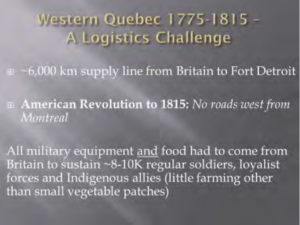 We learned that long before the Loyalists began to arrive in what would become Canada, the inhabitants of New France invented a new type of boat — a bateau — to haul cannons and supplies up the St. Lawrence River from Montreal, in order to transit the rapids and supply the western forts during the American Revolution and even earlier during the Seven Years War.
The official British Army ration per person per day was:
- 1 pound (0.5 kg) bread or flour
- 1.5 pounds (0.75 kg) salt beef (more if pork) This totalled about 5 pounds or 2 kg.
- 4 oz (110 g) rice or oatmeal
- 1/3 pint (150 ml) rum
This meant about 2,000,000 kg of provisions required annually by 1780 to support military posts, Loyalist raids, Indigenous raids, refugees plus transport all soldiers and all military stores.
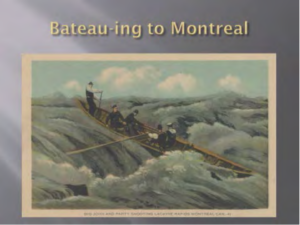 The bateau was pointed at both ends, like aboriginal canoes, but was much sturdier than the delicate canoes made of birch bark. The much larger Durham boat could not be hauled up the rapids. The bateau was ideal. It was usually steered by one helmsman while four other men rowed. It could transport about four to five tons of cargo, and could be hauled up the twelve sets of rapids that came between Montreal and Prescott.
Mr. More made us aware of just how many tons of food and gun powder, as well as the guns, had to be transshipped from ocean-going vessels to these bateaux. There was a fleet of 600 bateaux in service during the Revolution, employing between 3,000 and 6,000 men, almost all Frenchspeaking. Many were also employed at Carleton Island, off Kingston, once the British Navy set up a shipyard in 1780 and began building warships such as HMS Ontario, launched in 1780, and HMS Haldimand.
Then, of course, after the war ended, seven to ten thousand Loyalist refugees needed to be transported upriver into the heart of Upper Canada, together with their supplies and their animals. The Loyalists were provided by the British government
with army rations for two years (1784-86). More rations were provided after crop failures during the Hungry Year in 1787–1788.
French Canadian bateau men carried roughly 12 million pounds (6,000 tons) of rations each year to British Loyalists west of Montreal (over 1200 bateau loads or ~1 bateau every daylight hour during navigation season). An interesting fact was that the government maintained a fleet of 50 bateaux after the Revolution to serve the area of Montreal to Kingston. No civilian-owned boats were permitted on Lake Ontario until after 1787.
Mr. More went on to discuss the Kingston Royal Dockyard and shipbuilding in early Kingston and on Carleton Island. Several warships, including HMS Ontario, Seneca, and Haldimand, were built and/or crewed or commanded by Quebecois between 1780 and 1783 – half of the British fleet on Lake Ontario. French Canadians thus helped lay the foundations for the naval defence of Upper Canada and subsequent shipbuilding, which became a pillar of Upper Canada’s economy. Between 1784 and 1787 a French commander, R-H Laforce, surveyed Lake Ontario and is also credited for helping Major Ross construct the first British wharves in Kingston. The Naval Dockyard (where RMC is today) built several vessels between the wars, including HMS Royal George (1809). In 1811, before the start of the War of 1812 and the influx of British soldiers and marines, the majority of Provincial Marine sailors in Kingston were French Canadians.
According to the Duke of Wellington, control of the St. Lawrence River and Lake Ontario was critically important to the survival of Upper Canada during the war of 1812-14 (no good roads, so army could only be supplied by water). Several large warships including 44- and 56-gun frigates were built in Kingston (their remains still can be dived on, in the area). HMS St. Lawrence was launched in September 1814. She was a 112-gun battleship, the same class as Admiral Nelson’s ship HMS Victory – the largest sailing warship ever built on the Great Lakes.
Mr. More concluded by saying that the early French-Canadian mariners – sailors and ship-builders ˗ remain un-mythologized and unsung, but were essential for the defence, settlement and development of Upper Canada. Perhaps we thought our Loyalist ancestors rowed or sailed boats upriver themselves. Now we’ll have a better grasp of the situation when we next see a re-enactment of Loyalists being rowed ashore in a bateau. We’ll also understand why the Loyalists may not speak to the boatmen: the boatmen were almost 100% French-speaking, and probably very few Loyalists could talk to them!
David More’s historical novels The Eastern Door and The Lily and the Rose can be found in Kingston Frontenac Public Library, or can be purchased from the author. Information about the author including contact details can be found at http://www.queensu.ca/history/people/graduatestudents/phd/more-john-david.