
In Search of “Home” – The Loyalist Experience through War, Displacement,
and Settlement from the Mohawk Valley to the St. Lawrence River
(a talk by Jennifer DeBruin UE)
September 24, 2016
 A good number of members and several visitors came to hear Jennifer DeBruin UE whose topic was “In Search of “Home” – The Loyalist Experience through War, Displacement, and Settlement from the Mohawk Valley to the St. Lawrence River”.
Jennifer is descended from several Loyalist families who originally lived in the Mohawk Valley, among them Eamer and Alguire. Though the menfolk served in both the 1st and 2nd Battalions of the King’s Royal Regiment of New York (KRRNY), Jennifer explained that her 2nd Battalion ancestors chose to settle along the St. Lawrence near Cornwall, Ontario, rather than with the majority of the 2nd Battalion who lived in the Bay of Quinte region. This was done so they could be close to their once neighbours and family of the Mohawk Valley.
 The women, meanwhile, carried on as best they could during the war, looking after their children, animals, and properties. After the Revolution ended, when they were ordered to vacate their homes, many travelled to Canada along the waterways, but some crossed the Adirondack Mountains often without their menfolk along to help. Rather, they followed those sent to rescue them, which were often allied Mohawk guides.
In June, Jennifer attended the Second Annual Conference on The American Revolution in the Mohawk Valley, organized by the Fort Plain Museum and held at Fulton Montgomery Community College. The speakers and tours provided an opportunity for Jennifer to learn how the Revolutionary War progressed in the Mohawk Valley, and to see where her ancestors lived. She learned, for instance, that on May 19, 1776 Sir John Johnson and 170 of his tenant farmers and friends escaped from Patriot troops coming to arrest Sir John. They escaped in the night, making their way north to Quebec, where Sir John raised the KRRNY, which later returned to the valley and other regions to fight the “rebels”. Among these battles was the “Burning of the Valleys.” In October 1780, the Loyalist regiments were determined to not only rescue Loyalist families, but ensure those of the patriot cause would be unable to sustain themselves in the valley. The goal was to burn the crops and homes of the “rebels” and leave the valley smoldering, a tactic used by the Americans against the Loyalist families as well. Johnson Hall at Johnstown was not burned because it had been commandeered by the Patriots for use as their headquarters. (The Guy Johnson Manor also escaped the fires, but was very badly damaged by Hurricane Irene in 2011 and though now being restored, appears it will not be open to the public in the future, rather being used by NY State for offices.)
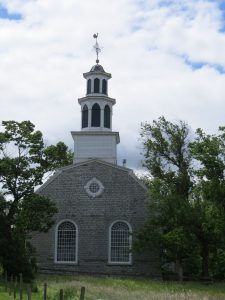
The Palatine (Lutheran) Church was built in 1770 between Nelliston and St. Johnsville, New York. It is one of the few pre-Revolution buildings remaining, as most others disappeared after the Burning of the Valleys. It is now on the US National Register of Historic Places.
Jennifer also visited Fort Klock where there is a “fortified house” — not a real fort, but the house had deep stone walls with gun slits for shooting out from the house, once the windows had been sealed with thick wooden interior shutters. Water was
brought right into the basement from a nearby creek so that families could barricade themselves in the house for weeks at a time. This is where area families sheltered during the Burning of the Valleys campaign.
Other places of significance to Loyalist history in the area she toured were the Oriskany Battlefield and Fort Stanwix, both in Rome, New York.
 Jennifer pointed out that when the Loyalists came to Canada, the refugees were not welcomed by the local population. Whether they settled in Nova Scotia or camped in tents at places such as Sorel, Quebec, the settlers already there were afraid the incomers would take their jobs or get better land. Though the American Revolution officially ended on September 3, 1783, with the signing of the Treaty of Paris, it wasn’t until early 1784 that land had finally been surveyed for the permanent settlement of the Loyalist refugees. Jennifer’s German Palatine and Scottish Loyalist ancestors went west to settle in what is now known as Stormont, Dundas, and Glengarry (SD&G) Counties, along the St. Lawrence River.
Palatine Church built 1770. Photo courtesy Jennifer DeBruin
The Loyalist families were not done with war yet. During the War of 1812, the Americans set their sights on Canada. By 1813, capturing Montreal became their objective as it would effectively cut the country in half, thereby weakening the ability of Canada to repel their advances. One skirmish of t his campaign happened on November 10, 1813 at Hoople’s Creek near Morrisburg. The Americans moving east were hoping to seize the ammunition stores in Cornwall, but as they made their way overland they were ambushed by 300 men of various SD&G militia units. Though the militia did not win the exchange — Jennifer’s loyal ancestor, Peter Eamer, being one of two wounded in the fight — the skirmish did delay the Americans moving forward. This delay provided enough time to load 150 wagons with the ammunition at Cornwall, which were then transported safely to Coteau-du-Lac, and out of reach of the Americans. The next day, the more famous Battle of Crysler’s Farm was fought. Thousands met in conflict upon this farmland turned battlefield near Morrisburg.
Finally, Jennifer showed some photos from the Lost Villages, six villages and three hamlets housing 6,500 people that were destroyed for the building of the St. Lawrence Seaway in 1958. Many of the villages had been founded by the Loyalists as part of the settlements of 1784. A few tombstones were moved to Upper Canada Village, but the graves of the King’s Royal Regiment of New York now lie under water, and their descendants once again had to find new homes.
NOTE: Jennifer mentioned there is much written about Sir John Johnson which may help those whose ancestors lived in the Valley and perhaps worked on the Johnson estates to find information about their own families. Jennifer referenced finding a 1916 thesis from the University of Illinois about Sir John online. An earlier published book, Orderly book of Sir John Johnson during the Oriskany Campaign, 1776-1777 (Albany, J. Munsell’s Sons; 1882) sounds like it might contain names of soldiers who fought under him. Copies are available at Queen’s University and in numerous libraries around North America.