
American Occupation of Montreal & The Richelieu Valley: 1775-1776
(a talk by Mark Gallop)
September 24, 2022
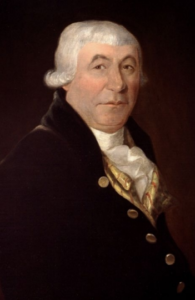 Mark Gallop started his talk by outlining what he planned to share with us and indicate some topics that he would not cover. His presentation focused on interesting people and their stories along with places involved in the occupation. Some personalities include Honorable James McGill, fur trader, and geographical places like the Chateau Reimes, as well as the Richelieu Valley which goes north through Lake Champlain, to St Jean-sur-Richelieu (earlier called Fort St. John) and following it northward the Richelieu River exits into the St. Lawrence River at Sorel.
[Above Left: Honorable James McGill, who was a Montreal businessman dealing in the fur trade, and whose estate was instrumental in the founding of McGill University, Montreal. ]
 Mark promised to not get bogged down on dates, battles, and politics. He indicated that this talk, for some obvious reasons, would not talk about women, indigenous, nor the Siege of Quebec.
The Americans did not come out very well at the end of the Occupation of Montreal, so therewill be no glorification of them at all. Their attempt to take over Canada was a bumbling fiasco.
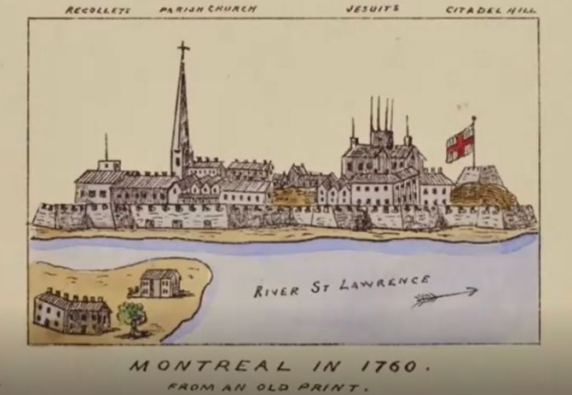
This image [above] is from shortly after British takeover of ‘New France’, also called ‘The Capitulation’, this drawing was made approx.1760.
https://www.thecanadianencyclopedia.ca/en/article/capitulation-of-montreal-1760
It must have been done by someone who had not been there at the time since the architecture is completely off. Some other images and maps of Montreal at that time are at the website shown above.
Montreal, a frontier town, was a booming walled city, 93 acres, with farming communities around the edges. In the census of 1771 and 1781 there were 12,000 inhabitants within the walls, with the majority being french-speaking. Montreal was the 4th or 5th largest community in North America, with Philadelphia, New York, Boston ahead of it. Those who were English were merchants, fur traders, old soldiers, and settlers who stayed after the 1760 ‘capitulation’.
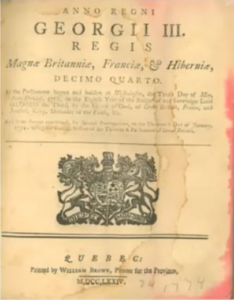 The Quebec Act was given Royal assent in 1774. Sir Guy Carleton, later Lord Dorchester, was the Governor of Quebec, and although he faced criticism, he made many accomplishments, so he deserves to be respected in the most part. This Act under Carleton set the terms for how to incorporate French Canada into the British governance.
In regard to law, ‘The Quebec Act’ kept French Law for Civil matters; the Seigneurial system was kept, the Roman Catholic religion was kept, and Catholics could hold office. It created an Appointed Legislative Council. And it redefined the boundaries of ‘Quebec’, to include much land around all around the great lakes. That took effect in May 1, 1775.
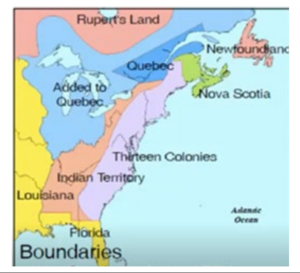 The Quebec clergy was very contended with this act. Those unhappy were many Montreal merchants, who had active trade with the American colonies. Those land ‘speculators’ who were hoping to settle the Ohio lands were unhappy that those lands were no longer available. Representation for taxation as ‘promised’ did not come about and that disappointed many.
A George III statue was placed on Place D’Armes, Montreal. The bust was vandalized, but it was found and salvaged from bottom of a well in 1875 after which it went to the McCord Museum, Montreal after sitting on the archivists’ desk for some time.
The First Continental Congress ( Pro-‘America’) was held in Sept-Oct 1774, at Philadelphia. The main topics were not just taxation without representation but also focused on the Quebec Act and its implications. A letter was written to the ‘Habitants of Quebec’. It was translated and two thousand copies were printed and sent to a Montreal merchant for underground subversive distribution to drum up support for what they hoped would be a continental rebellion.
Early in May 1775, the ‘Americans’ captured Fort Ticonderoga located in the south end of Lake Champlain, and at the end of May 1775, a Second Congress was held and a second letter was sent out similarly. The actual Congress continued technically for 4 years. Thomas Jefferson stated this about the War of 1812 but it shows the same attitude of the Americans at this time. That the overturning of Canada was a “…mere matter of Marching”, anticipating little resistance.
Roads of the time: Waterways were the main roads. There were two land roads going from Fort St John and the Richelieu to Montreal along with only a few others in the area.
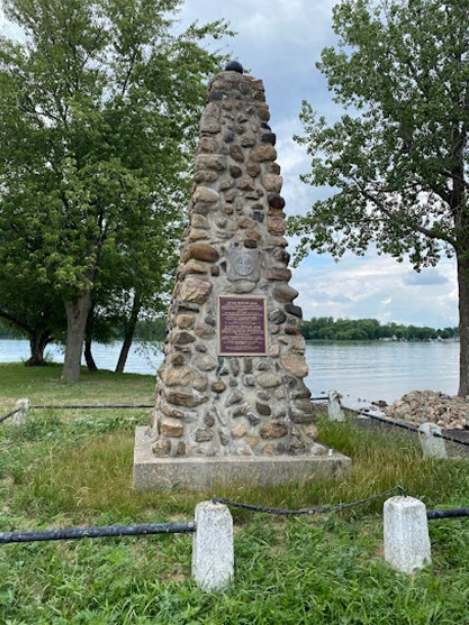 Nearby, the ‘State’ of Vermont was known for the Green Mountain Boys who were an effective militia. In Aug 1775, the Green Mtn Boys sent out a scouting party led by a man named “Remember Baker”, who was a 1st cousin of Ethan Allan. The story goes that he was a redheaded, freckled-faced ‘giant’, was shot and killed at “Remember Point” by some Indigenous who beheaded him, and took his head on a pole to Fort St. John. There, officers bought it from the Natives, and buried it, and sent men to collect and bury his body. His was regarded as the first death in the ‘Invasion of Quebec’ conflict and was recognized by DAR who commemorated his death with a cairn at Noyan, Quebec, at “Remember Point”.
Fort St. John: The area is very flat and had no advantageous land-forms for defenses, but this fort was built and it withstood a 25 day siege early on, and the British Major Charles Preston held-off another 45 day siege by the ‘Americans / Continentals’ under Montgomery. Archaeology has revealed numerous items of the 1774 time-period.
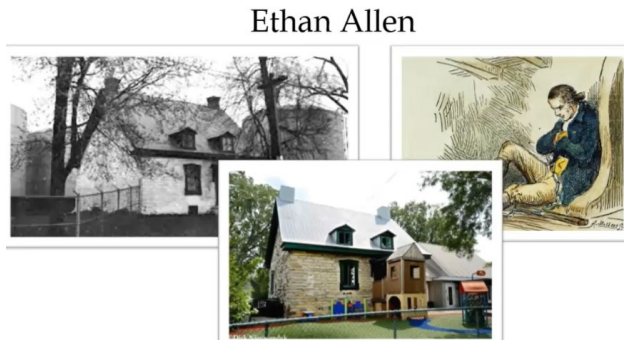 In Sept 1775, shortly after the siege, Ethan Allan decided, contrary to orders, to lead his Green Mountain Boys, to cross to the eastern end of the Montreal Island, and he failed to meet another group, and they were besieged. Guy Carleton with a small troop, sent the Americans retreating. With about 31 of Ethan Allen’s Green Mountain Boys men remaining, they hid in the above very old farmhouse. Allen was chained and taken as prisoner back to England. Peter Johnson, son of Sir John Johnson was the arresting officer. The 1740 farmhouse was moved in 1970, restored as a day care centre.
After the 45-day siege ended, the ‘American’ General Richard Montgomery made his way to Montreal, via Nun’s Island, and landed with troops. Next day, Carleton stayed with his men at the Citadel and twelve Montreal citizens met Mongomery, one was McGill. This ‘Occupation’ was a discussion and negotiation, not a battle or conquest. These Americans hoped to win the Montrealers over to their side against the British. They wanted to maintain the Indigenous trade, their Quebec and Montreal court system, and some were in favour of American system. Some other terms were discussed. Most just wanted to get on with their lives.
During the Occupation for the winter of 1775, the ‘Forretier’ house was General Montgomery’s residence. Since then, its uses included the Willis piano store and this was Mark’s Great Grandfather’s Sewing Machine and Piano location. It was built in 1767, and demolished 1940. Now it is a parking lot. https://antiquepianoshop.com/online-museum/willis-company/
Chateau Ramezay, built in 1705, was the Continental Army HQ during the Occupation. It had been the Governor’s mansion in British regime and was the seat of Government until 1849, except for during the American occupation. It is now an excellent museum.
Another old house in Montreal is the Becancour House, that of Thomas and Jane Walker, a merchant supporter of the American efforts. They came to Montreal in 1763. It seems that he was a disagreeable merchant. By 1775, it was clear to others that he favoured the Americans. His home was visited for long and short stays by delegates from American Congress; Benjamin Franklin who did not enjoy this trip; Samuel Chase, from Maryland; Charles Carroll of Maryland, a Catholic and the last living signer of the Declaration of Independence who died at the age of 94; Jean Carroll (cousin of the mentioned Charles Carroll), a Jesuit priest, a future Bishop. A Philadelphia printer, Fleury, came with equipment and stayed and became an upstanding citizen, later in 1778 founding the Gazette Litteraire, a precursor to the Montreal Gazette. https://www.biographi.ca/en/bio/mesplet_fleury_4F.html
Jane Walker travelled with Franklin and she was found to not be an agreeable companion according to Franklin, and that the Walker couple were good at making enemies. In 1777, the Becancour house was purchased by James McGill, but it too no longer is standing. https://www.catholiceducation.org/en/culture/history/catholic-founding-fathers-the-carroll-family.html
Moses Hazen was born in Massachusetts, enlisted at age 22 and after Gen. Richard Montgomery departed, Moses was in command of Montreal. After the death of Montgomery, David Wooster, the newly-assigned Commander-in-chief of the ‘Provincial’ [Continental / American] Army against Quebec, ordered that mass houses be closed on Christmas eve. He tried to stop the Indigenous trade and tried to circulate continental currency. These and other approaches were very unpopular, although he had difficult conditions to manage. Hazen was part of the expulsion of the Acadians, at Fredericton. Hazen was a wheeler-dealer, acquired lands in Richelieu near Fort St, John, and left a paper trail of disputes and debts. In 1790 a comment was made about his obstinate temperament, and about his vacillating as to which side he supported. Tried to raise a 1,000 regiment, but only found about 500.
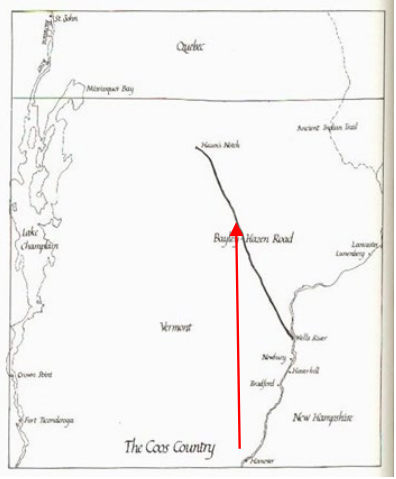 LEFT: Map of northern Vermont showing the route of Hazen’s Road built by Hazen’s Regiment in preparation for a second invasion of Canada, which never occurred.
The Congress delegates and the troops left in June of 1776. Hazen retreated across the border with a few hundred men. Later these troops were successful elsewhere and were known as ‘Hazen’s infernals’. He made another attempt to return to ‘Canada’ which failed. Hazen’s name is now attached to The Bayley-Hazen Road (Red Arrow) from Wells River to Hazen’s Notch.
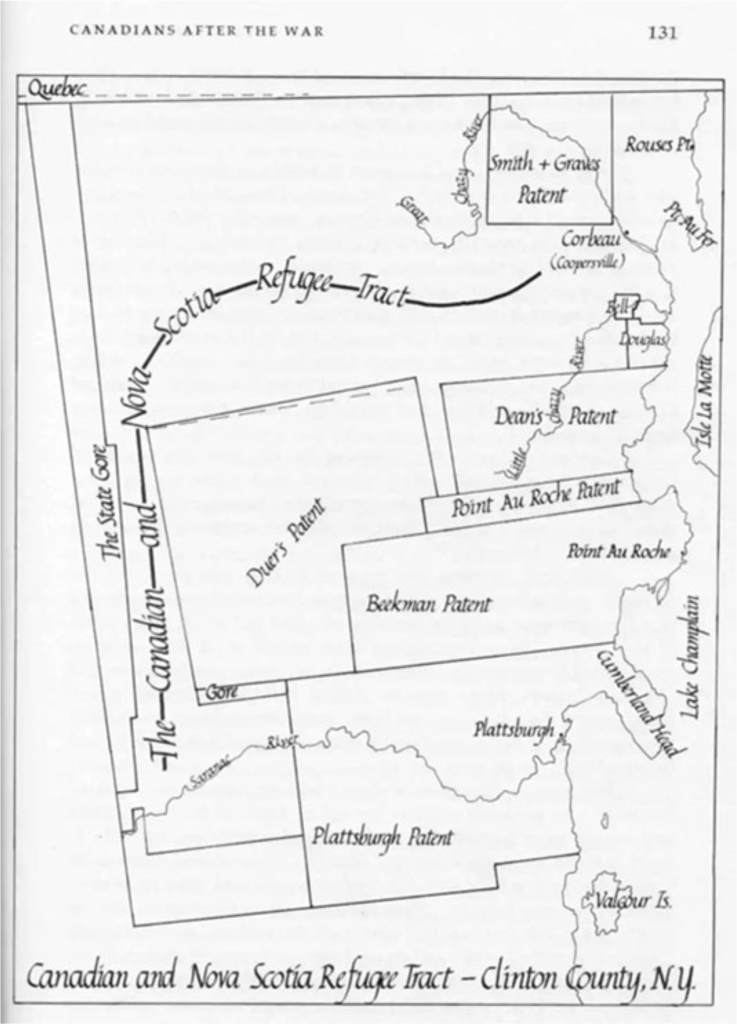 Canadian and Nova Scotia Refugee Tract: In addition to Loyalists who were largely ‘war refugees’, there were others who sided with the new ‘Americans’ who moved from ‘Canadian’ areas including ‘Nova Scotia’ to ’American’ areas. A refugee tract of available land was used up to 1803 by those in ‘American refugee camps’ at Albany and Fishkill. “When New York State enacted Chapter 63 of the laws of 1784, it directed the Surveyor General to ”…lay out such a number of townships of unoccupied lands for the Canadian and Nova Scotia refugees.” The entire 231,540 acre tract was in Clinton County, including a section along the shore of Lake Champlain. As the time allotted for refugees to make their claims ended, very little of the land was occupied and most of it reverted to the state. https://empirestateplaza.ny.gov/system/files/documents/2019/10/refugeelands.pdf
One ‘Canadian’ ‘war refugee’ who was a follower of Hazen was Jacques Rouse from what is now New Brunswick. He was an Acadian, was previously expelled to Quebec. After 1776, he retreated to New York State and his name is shown in New York State Clinton County, at Rouse’s Point, very close to the current Canadian-American Border.
In this same area existed Lot 62 with 80 acres was initially assigned to Moses Hazen, later transferred to William Hazen. At his death in 1814, it was purchased by the U.S. Government due to its proximity to the international border with Canada, with whom they had just been at war. They started to build Fort Montgomery named after Gen R Montgomery. It was nicknamed Fort Blunder because it was found to be on the wrong side of the New York / Canadian border. The early fort is now mostly demolished, but other construction attempts were since including for the American Civil War. https://en.wikipedia.org/wiki/Fort_Montgomery_(Lake_Champlain)
In closing Mark told us about a sign he saw that suggested that the Americans and Ethan Allen (STORES) are still “Coming Soon!”.
HANDOUT & RESOURCES: Mark Gallop, U.E. – September 2022
PLACES:
FORT SAINT-JEAN NATIONAL HISTORIC SITE & MUSEUM, a National Historic Site, on the grounds of the Royal Military College, St-Jean-sur-Richelieu https://www.museedufortsaintjean.ca/EN/index-en.htm
CHATEAU RAMEZAY NATIONAL HISTORIC SITE & MUSEUM, Old Montreal https://www.chateauramezay.qc.ca/en/
McCORD STEWART MUSEUM, downtown Montreal https://www.musee-mccord-stewart.ca/en/
BOOKS:
Hatch, Robert M., Thrust for Canada: the American Attempt on Quebec in 1775-1776, Houghton Mifflin, 1797 (out of print but in many libraries)
Everest, Allan S., Moses Hazen and the Canadian Refugees in the American Revolution, Syracuse Unbound, 2018 https://press.syr.edu/supressbooks/177/moses-hazen-and-the-canadian-refugees-in-theamerican-revolution
Baby, François, Quebec during the American invasion, 1775-1776: the journal of François Baby, Gabriel Taschereau, and Jenkin Williams, Michigan State University Press, 2005 https://msupress.org/9780870137402/quebec-during-the-american-invasion-1775-1776/
ONLINE:
Dictionary of Canadian Biography online: http://www.biographi.ca/en/
(Benedict Arnold, Guy Carleton, Moses Hazen, James McGill, Richard Montgomery, Thomas Walker, and others)
Canadian Participants in the American Revolution – an Index, at FamilySearch.org: https://www.familysearch.org/library/books/records/item/404267-canadian-participants-inthe-american-revolution-an-index?offset=
Many Thanks to Mark!