
Coping with the Wilderness: Telling Women’s Stories of Early Upper Canada
(a talk by Dr. Jane Errington)
January 26, 2013
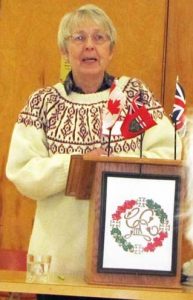
We had the pleasure of hearing a talk by Dr. Jane Errington, professor of history at the Royal Military College of Canada and Queen’s University.
Jane’s title was “Coping with the Wilderness: Telling Women’s Stories of Early Upper Canada”. She explained that women with money, such as Elizabeth Simcoe (wife of the first Lt.-Gov. of Upper Canada, John Graves Simcoe) conveyed through diaries and letters home to family in England that life in Upper Canada was busy and interesting: not greatly different than life had been at home in England. However, others found the experience of coming to a new colony difficult and lonely. Margaret Ryerse came as a Loyalist, and her daughter Amelia Harris left letters and other documents describing Margaret’s life: no close neighbours, and dealing with the need to adapt to a new environment while sttempting to recreate parts of her old life such as family “entertainments”.
Frances Stewart, who arrived from Ireland in 1822, wrote letters home in which she admitted her excitement at the prospect of a new country was mixed with apprehension. She was a “gentlewoman” who settled near Rice Lake and raised ten children in a log house. Her letters home told how she still made time each day to read, to keep her mind stimulated. Her family was well-enough off that after five years in the wilderness her cousin could send her a piano!
Frances Stewart was helped by servants, but Dr. Etherington quoted from another Irish woman, Fanny Hutton, who bought a farm near Belleville in 1834. She also wrote letters describing her life with her five children. and a rather feckless husband: she was just barely getting by.
Both Frances and Fanny Jane lived in the country; Jane recommended Anna Jameson’s Winter Studies and Summer Rambles in Canada (published 1838; reprinted 1990, New Canadian Library) as an example of the life of an urban woman of the time.
Many letters and diaries of early settlers may be found at the Archives of Ontario.