
Heading North, Moving West – MALCOLM family
(a talk by Dean Taylor)
September 26, 2019 – Newsletter Issue #5
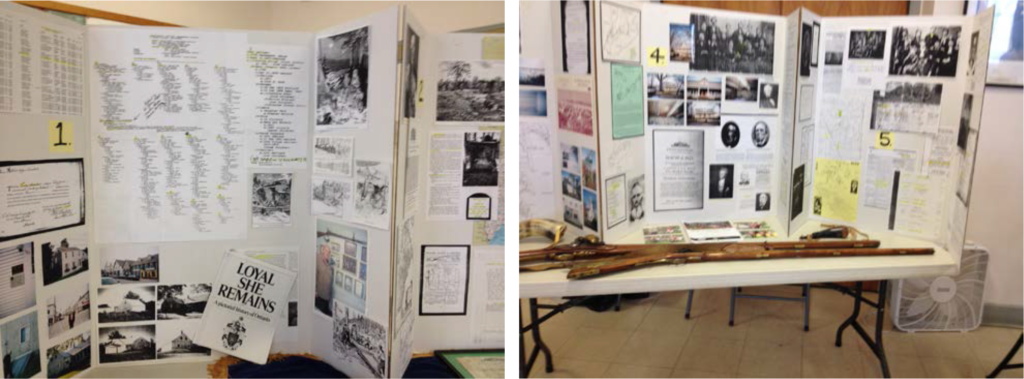
Past President Dean Taylor brought a fascinating display of items connected to the MALCOLM family, plus some weapons from the period that are not actually family heirlooms.
Dean’s talk followed on from Leigh Smith’s presentation last January on the “Castine Loyalists” – because Dean’s UEL ancestor was one of those founders of St. Andrew’s, NB. Dean called it “Heading North, Moving West” – since that’s exactly what the Malcolm family did.
Duncan Malcolm, a weaver, left Scotland and settled on Long Island in 1763. When the Revolution came, he would not take the Oath of Allegiance and moved to Saybrook, CT hoping to avoid conflict.
Duncan’s son Finlay Malcolm, born 1751 in Scotland, was living in Pentecost, Maine from 1769 onward, working in shipping and trading. By 1776 he was supplying the British-occupied Fort George in Castine, and according to a diary kept by the fort’s doctor, Finlay Malcolm was the only civilian allowed to enter the Fort without a pass.
Like his fellow Loyalists, after the Treaty of Paris settled the boundary line between the USA and British North America and Castine remained part of Maine instead of being included in New Brunswick, Finlay dismantled his house and sailed it from Penobscot ME to St. Andrew’s NB. However, not all that long after doing so, he decided to move his family away from the coast: his sixth son was born in Kingston, Upper Canada in 1798.
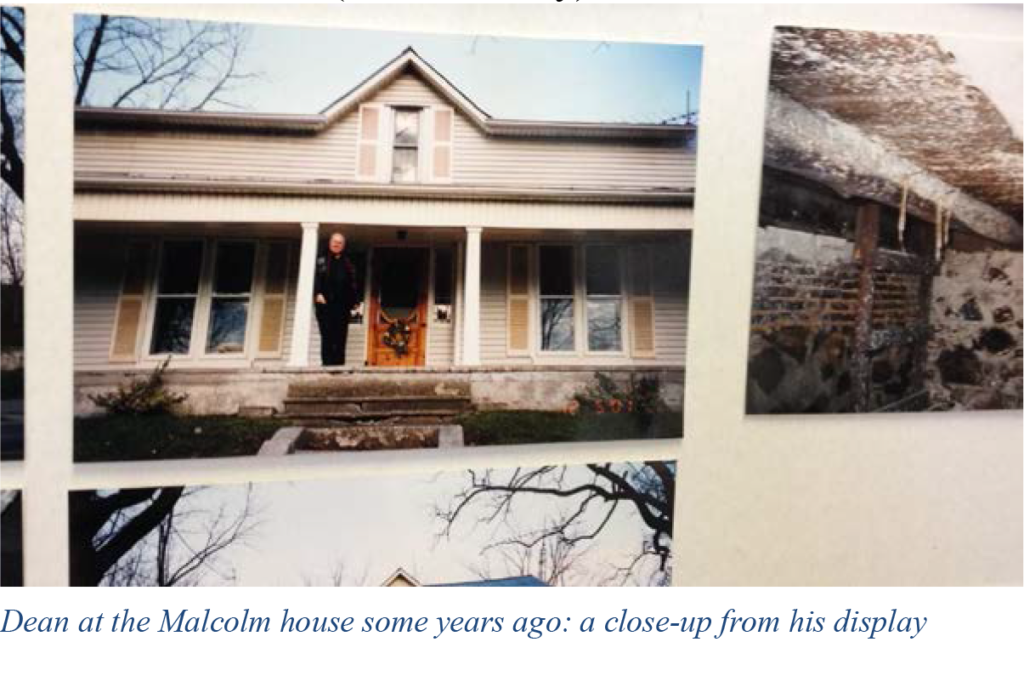
Kingston was evidently just a stopover on the way further west. Finlay Malcolm and family arrived in Oakland (Brant County) and built a house in 1802. The house is still in Dean’s family.
Finlay’s sons included John and Finlay Jr, who eventually built five mills in a hamlet on the Grand River outside of Oakland that was first known as Malcolm’s Mills and eventually renamed Scotland.
During the War of 1812, the Battle of Malcolm’s Mills occurred on November 6, 1814. An invading American force of about 700 mounted infantry under Brigadier General Duncan McArthur managed to outflank a group of 550 combined British and Canadian militia, commanded by Colonels Ryerson and Bostwick, resulting in 18 dead and 9 wounded, and 126 taken prisoner, whereas the Americans claimed to have lost only 1 dead and 6 wounded. The remaining British forces managed to escape (Wikipedia).
John Malcolm had previously sold whisky to the American troops: Dean has the receipt for the purchase of 10 gallons by the Americans. However, during the Battle some American troops arrived at John’s mill and threatened to hang him in front of his wife and children. Dean said the story passed down in the family is that John noticed a Masonic emblem on the commander’s uniform and managed to convey a secret signal that he too was a Mason. The Americans released him but did burn his mill anyway.
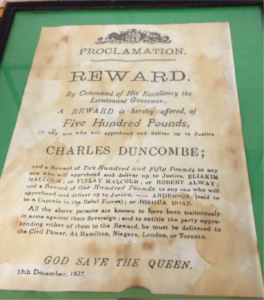 Another son of Loyalist Finlay Malcolm, Eliakim, was the first warden of Brant County when the government structure was changed from Districts to Counties. Despite this, he sided with Dr. William Duncombe, an ally of William Lyon Mackenzie, at the time of the 1837 rebellions. (In Brant County, the rebels were dispersed by Sir Allan MacNab, later the Premier of the Province of Canada, who rode out from Hamilton with soldiers.)
Eliakim escaped to Michigan and after three years he was pardoned and returned to Ontario. His son Finlay III was held in jail at Kingston, to be sent to Australia. He only reached England on his way to the penal colony, was then pardoned by Queen Victoria and sent back to Canada with the gift of a bible. Dean’s display covers five boards and is full of meticulous research and interesting photos. We all appreciated hearing about the Malcolms, from Loyalists to rebels to the present day.