
Loyalist Clothing: Design and Fabric for Period-Appropriate Attire
(a talk by Nancy Cutway & Anne Redish)
September 23, 2017
Our topic was “Loyalist Clothing: Design and Fabric for Period-Appropriate Attire”. First we watched a short video showing an 18th-century lady being dressed with the assistance of two maids. It has an excellent narration that explains each garment shown, with additional comments about possible variations for winter warmth, etc. The video, produced by the National Museums of Liverpool (England), is available for anyone to view on YouTube, entitled “Getting Dressed in the 18th Century”, at https://www.youtube.com/watch?v=UpnwWP3fOSA&t=2s.
Nancy Cutway, dressed in her handwoven linsey-woolsey mantua (dress) with cotton petticoats, shift and cap, spoke about the experience of making the fabric back in 1983-84, leading up to the Loyalist Bicentennial held here in Kingston. As an inexperienced weaver at the time, she made several mistakes but imagines that similar experiences might have been encountered by Loyalist women who suddenly had to learn how to weave when they no longer had access to established weavers in their towns, when they had to leave their homes in the former Thirteen Colonies.
Nancy gradually removed the layers of clothing she wore so they could be passed around and examined. She mentioned that the instructions and patterns were obtained from UELAC in 1983 and were based on information known then. Most of the garments – shift and petticoats – are made only from rectangles of fabric; no “pattern” is used, simply straight cuts measured out to a certain length. Smaller rectangles are added to the underarm and bottom side seams of the shift or chemise in order to provide some shaping and freedom of movement, since darts were unknown at the time.
Anne Redish then used a Powerpoint presentation to display sketches of styles as they changed throughout the 18th century and into the 19th. She pointed out problems with a couple of commercial “early American” patterns that have misinterpreted clothing lines as depicted in later paintings that purport to show the Revolutionary War era.
Anne donned a couple of garments to show how they were fashioned. The hip ring (white ring in the photo of clothing rack in next column) actually served a purpose when worn over the chemise and petticoat and under the skirt: it kept the various layers from riding up as the wearer moved. (If you watch the video mentioned above, you’ll see a hip ring used by the lady there too.)
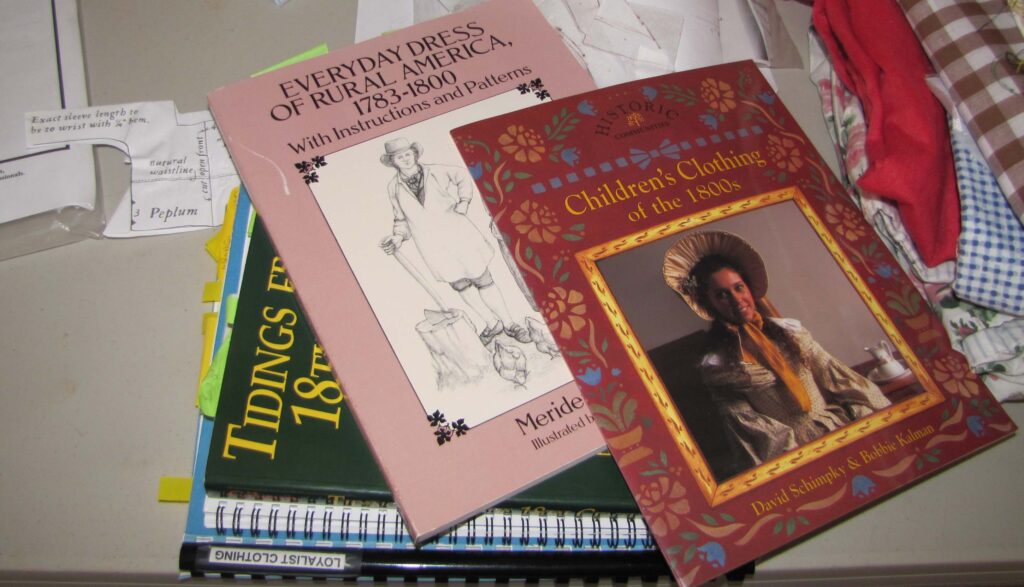
Anne has an extensive personal library on garment construction, in part because she taught costume making at Queen’s University for a number of years. She recommends the two books on the next page (below) as the best for our purposes.
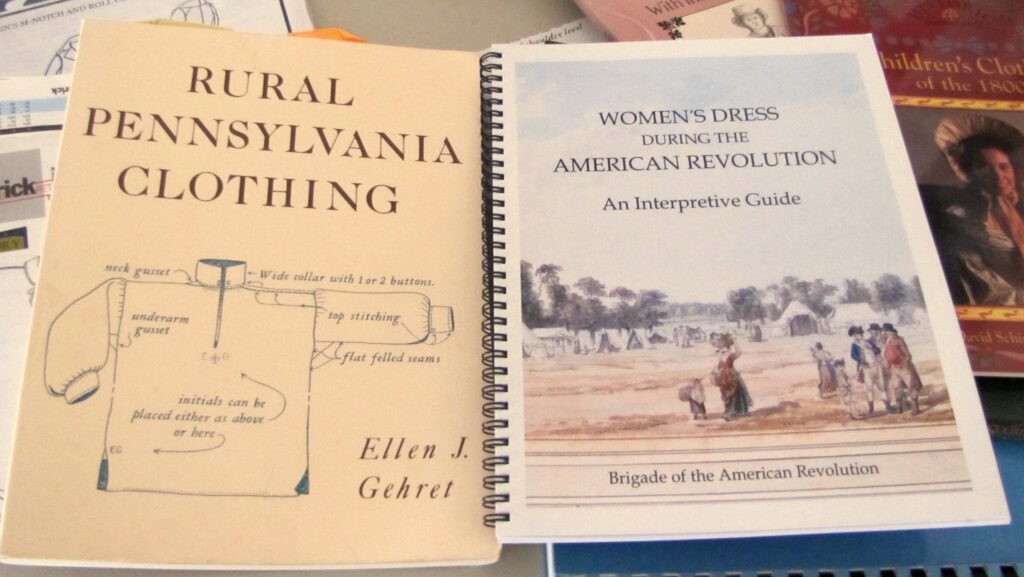
Anne had brought several other books and samples of fabric both good and
bad for Loyalist clothing. She also prepared a couple of handouts. Anyone who was unable to attend and would like Anne’s handout on either “What to do with your neglected Loyalist Garments” or another on Vocabulary and Notes with a key segment about why cotton was not in generous supply in the Loyalist era (wool and linen being the usual materials used), please feel free to contact Anne at ar11@queensu.ca.
Due to the extreme heat of the day, we decided as a group to postpone consideration of fabrics appropriate to the 18th century to a later time.
We did learn that wool and linen are the most appropriate choices, colours should be relatively subdued — no neon orange! — and stripes or dotted patterns with a definite vertical look are fairly accurate while large recurring or reversing prints are not.
We hope in the future to see several more members honouring their Loyalist ancestors by dressing in clothing they might have worn.
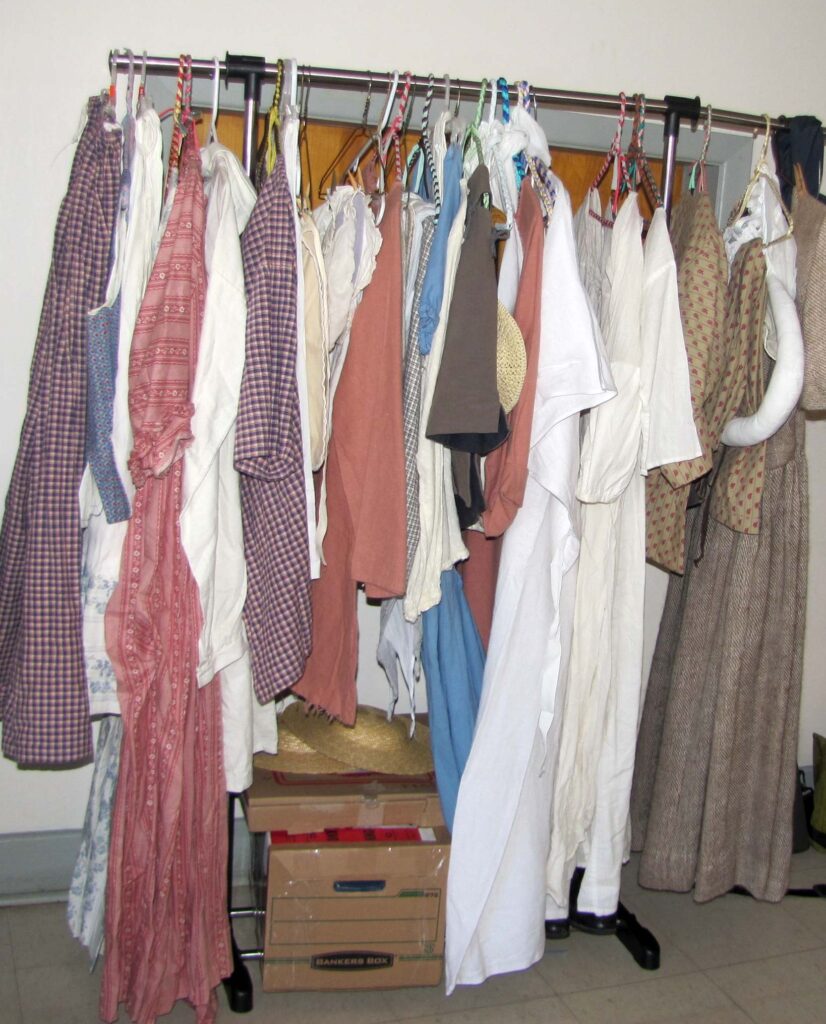
[Above] An assortment of Loyalist women’s clothing, thanks to Anne Redish and to the UELAC Costume Branch at Dominion Office. The “Costume Branch” is no longer active, but the garments still exist.
Note that the colours are not bright. The chemical dyes which permit vivid colours were not developed until late in the 19th century. Patterns are relatively small, since prints were applied using a roller in fairly narrow strips. Solid colours were much more common.
Women always wore a cap, both indoors and out. A flat straw hat, as seen to the left atop the box, would be worn over the cap when going out in the sun. It would be tilted down to cover the face and shade the eyes from the sun.
Resources Anne suggested for our further study include:
Sutlery: http://www.townsends.us/
http://www.loyalistarms.ca – Canadian, but Atlantic-oriented
http://attheeasterndoor.wixsite.com/attheeasterndoor
https://www.thequartermastergeneral.com/store/
Clothing making supplies: http://wmboothdraper.com/ and https://atthesignofthegoldenscissors.com/
Skirt: instructions including pleating / no pattern, http://fashionablefrolick.blogspot.ca/2011/04/threadedbliss-tutorial.html
Cap: online still images, tutorial http://artbeautvandwell-orderedchaos.blogspot.ca/2009/05/how-to-make-18th-century-cap.html
Stays: http://www.farthingales.on.ca/ (Stays supplies, no 1775 era patterns, some Regency patterns)
Breeches pattern: 1730s Breeches Pattern by (I believe) Norah Waugh. Period Impressions has a pattern VERY similar to this, https://www.pinterest.co.uk/pin/465489311457147433/
Patterns: http://www.jpryan.com/
Study of Quilted Woman’s Vest / Jumps http://sharonburnston.com/quiltedwaistcoat.html
Books:
- Gehret, Ellen J, Rural Pennsylvania Clothing
- Gilgun, Beth, Tidings from the 18th Century
- Wright, Meredith, Everyday Dress of Rural America with Instructions and patterns (grid drawings)
- Brigade of the American Revolution, Women’s Dress during the American Revolution, an Interpretive Guide.
Uniforms:
https://www.scribd.com/document/251081290/British-Army-His-Maiesty-s-Loyalists-lndian-Allies