

Provincial Marine to Royal Navy: Archaeological Evidence
of the War of 1812 at Kingston’s Naval Dockyard
(a talk by Sue Bazely)
March 28, 2015
 Sue Bazely, well-known archaeologist, spoke on Provincial Marine to Royal Navy: Archaeological Evidence of the War of 1812 at Kingston’s Naval Dockyard Sue pointed out that beginning in 1783, settlement of the Loyalists was concentrated along the St. Lawrence River, Lake Ontario and the west side of the Niagara River. There was a severe shortage of commercial ships available to move the Loyalists around and facilitate trade, so the Provincial Marine and their ships, stationed in Upper Canada after the American Revolution, were used for commercial transit to alleviate the shortage. The Provincial Marine was based at Carleton Island until 1789, when merchants lobbied for it to move to Kingston, to Point Frederick. By 1790 the Naval Dockyard was established. Four large gunships were built there between 1800 and 1812.
November 10, 1812 marks the date of Kingston’s only involvement in the War of 1812, a barrage from the gun batteries at Point Frederick, Murney’s Point and Missisauga Point against the ships of Commodore Isaac Chauncey of the US. In spring 1813 the Royal Navy under Sir James Yeo engaged Chauncey’s fleet again, and successfully blockaded Sackett’s Harbor, NY.
Meanwhile, since the start of the war there was a boatbuilding frenzy in the dockyard. HMS St. Lawrence was the largest ship with the most guns ever built on the Great Lakes. And the dockyard was the largest Royal Navy dockyard on fresh water, anywhere in the world.
The men also built blockhouses, five in a line along West/Sydenham streets and one on the east side of the Cataraqui River at Point Frederick and Fort Henry. Hundreds of civilian shipwrights and carpenters were brought from Quebec City to join local employees, and by 1814 there were up to 1200 staff at the Dockyard. Several structures were built that show up on various early maps, including a hospital 64×38 ft on a stone foundation and 3 other long, narrow buildings.
The civilians had to build their own shanties, mostly from scrap lumber – in 1815 there were apparently 34 of them before Commodore Owen had them extend the hospital yard northward and fix up some shanties while tearing down others. In 1819 Commodore Barrie urged them to get rid of the “dangerous wooden buildings” and substitute stone or brick buildings; in 1822 a row of 16 stone cottages was built.
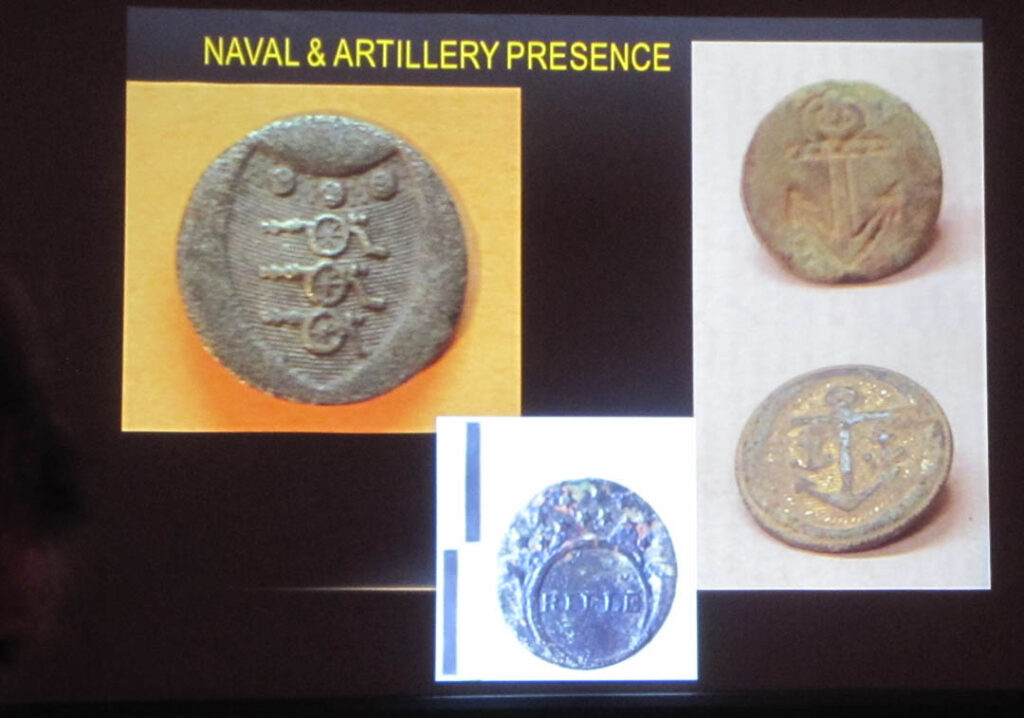
Previous excavations in the 1960s had shown what little remains of the blockhouse and an artillery barracks, both of which were mostly obliterated by the 1840s erection of the Martello Tower on Point Frederick.
In 2004 a new dormitory was to be built at RMC. This afforded an opportunity for archaeological investigations. They did find evidence of 1812 Encampments, with ash deposits from campfires, ceramics, large pieces of animal bones, glassware, musket balls and military buttons, and coins.
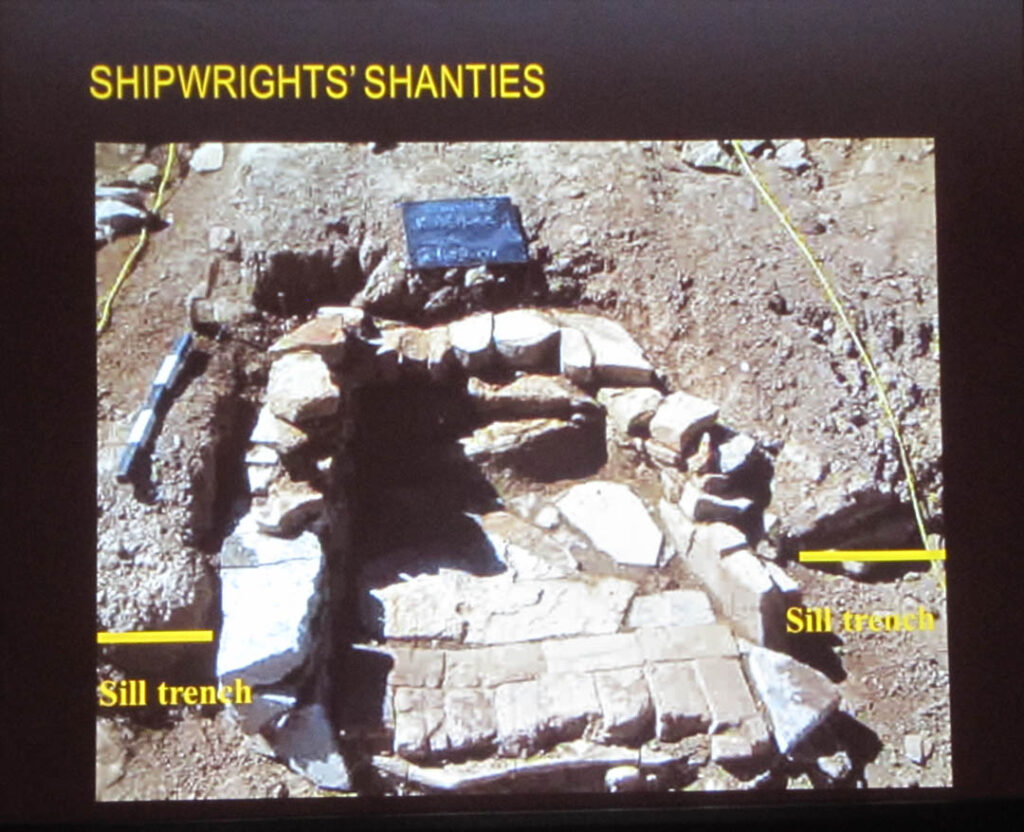
Excavation also uncovered a fireplace that probably came from one of the shipwrights’ shanties. Among the artifacts located there were some small figurines of saints or madonnas which might have belonged to a worker who was part of the recruitment from Quebec City. Another dig in 2007-08 around #10 of the 16 stone naval cottages found an earlier foundation, believed to be one of the 3 long structures shown on the 1815 map.
For many years it was thought that the 1812 hospital may have become today’s Commandant’s Residence, but the 2007 dig found the foundation of the hospital, located northwest of the current commandant’s residence — which likely started life as the surgeon’s quarters, set apart from the hospital. This dig also found a stone-lined drainage ditch meant to drain the hospital yard. An exploration of the former barracks and canteen buildings on the hill found an intact chimney base, carpenter’s tools, and close to 200 coins. Digging in the privy pit for the officers’ quarters produced much china, and many liquor bottles!
The Royal Navy dockyard at Point Frederick closed down in 1853.