
Teenagers, The Same Then And Now
(an article by Nancy Cutway)
January 2020 – Newsletter Issue #1
It’s surprising how many young Loyalists are being discovered in the records. Recently
two other members of Kingston and District Branch have spoken about finding 12-yearold drummer boys among their family members who participated in the American
Revolution. I have recently learned that my direct ancestor, Jacob Dulmage, likely
served as a soldier while he was no more than thirteen years of age.
This came to light in 2019 when I began to explore Jacob Dulmage’s connection to Ernestown Township in Lennox & Addington County. His name appears on the 1783 map of “Ernesttown*” that was drawn in Quebec, assigning lots to the members of Jessup’s Rangers prior to their actual arrival at Bath in 1784 (map found at http://ao.minisisinc.com/FS_IMAGES/I0043486.jpg). (I had always associated my Dulmage family members with Marysburgh Township in Prince Edward County, and had not realized they were assigned land further east – although probably they never resided in Ernestown, or not for long.)

Jacob apparently enlisted in Jessup’s Rangers alongside his father David (who was ultimately a Sergeant by the end of the American Revolution), and served for six months up to the end of the Revolution in 1783. His age at the time is open to question. The traditional year of his parents’ marriage is 1770 in Pennsylvania; if he was born after their marriage, he would have been only about 12 when the war ended. If, as is stated in the documentation signed by Colonel Edward Jessup which he submitted in support of his petition**, he was 14 at the time, then he would have been born in 1768 or 1769, one or two years before their marriage; or else the accepted year of their marriage is incorrect.
Descendants will likely never know exact dates of either the marriage or Jacob’s birth. Fourteen may have been the minimum age required to enlist as a soldier (rather than drummer boy) during the Revolution, so fourteen was the age Jacob claimed to be. In 1819 he submitted a claim to Samuel Smith, Administrator of the Government of the Province of Upper Canada for replacement documentation of his ownership of Lot 13, Concession 5 in Ernesttown Township, because he needed rightfully to own it before he could sell it. (He did sell it, on 11 February 1820, to Michael Asselstine of Ernesttown Township, for £75. By that time he was living in Marysburgh Township, and probably had been almost since arriving in Canada.) As proof of the service that earned him Lot 13, Concession 5, Ernesttown Township, Jacob submitted his discharge paper which was signed by Major Edward Jessup on December 24, 1783.
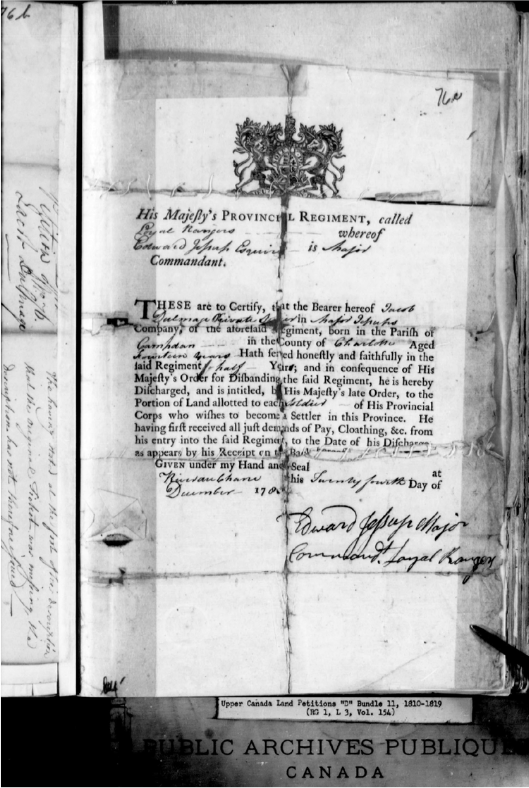
[Prev: Petition of Jacob Dulmage, accompanying document 76c: Certificate of service in Major Edward Jessup’s company at age fourteen in December 1783. Library & Archives Canada, microfilm C-1744: Upper Canada Land Petititions “D” Bundle 11, 1810-1819 (RG 1, L 3,Vol. 154).]
Why did Jacob Dulmage need to request a confirmation of his right to the land? Because he was indeed a teenager when he was first given his land ticket, and apparently teenagers in 1783 were as unfocused as some can be in 2020. As he states in his petition (below), he lost his ticket.
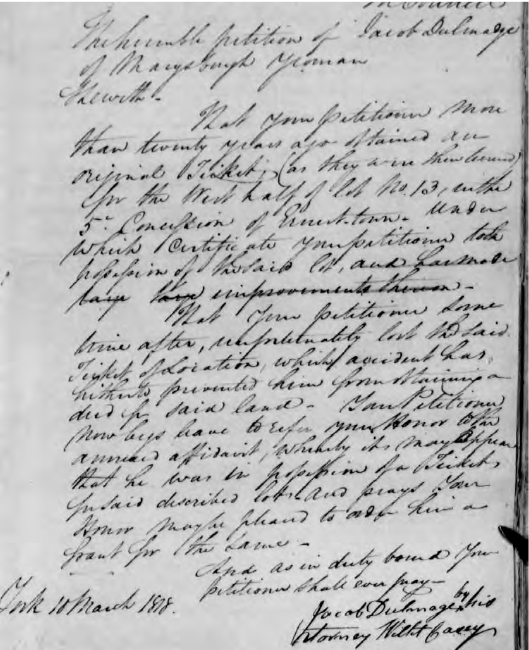
Upper Canada Land Petitions “D” Bundle 11, 1810-1819 (RG1, L3, Vol. 154 – microfilm C-1744, Library & Archives Canada)
I can almost hear the conversations:
1783 or 1784:
Clerk (handing him land ticket): “Now keep this safe, lad – it’s your right to 50 acres of land.”
Jacob, age about 14 (placing piece of paper into his knapsack): “Yeah, whatever.”
1818:
Sarah Huff Dulmage (Jacob’s wife): “Well, you’d better find it. We need to sell that land, we’re not using it and we can use the money. Don’t forget, we now have 11 mouths to feed.” [Two more children were born after the sale of the land.]
Jacob Dulmage (age about 48): “I’ve looked everywhere. I’ll have to apply for a new ticket.”
Fortunately the government officials looked favourably on Jacob’s application, no doubt because they could see from the 1783 map that he was assigned the 50-acre property. A rough calculation using various online converters shows that £75 in 1820 is equivalent to at least $10,000 today, a significant amount of money: well worth obtaining a substitute location ticket.
Jacob Dulmage drowned on September 26, 1841, at the age of about 71, while rowing across Hay Bay after speaking at a church meeting (he was a Methodist lay preacher). Newspaper reports suggested that an oar may have broken in rough water and he was thrown overboard.
Jacob Dulmage is my great-great-great-grandfather.