
Palatines: Refugees from a Different Time
(a talk by Deb McAuslan)
January 28, 2017
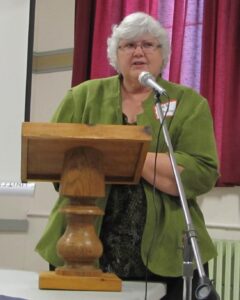
Deb McAuslan addressed the topic of “Palatines: Refugees from a Different Time”. It was interesting to hear the parallel experiences of the Palatines and today’s refugees: initially welcomed in England but then complaints arose about them taking work from native-born citizens. And when several thousand were sent to Ireland (to “dilute” the Roman Catholic population) and several more thousand were sent to New York colony (to produce pitch and tar for the English Navy), the lack of support from the British government meant that these plantations were not successful.
As Deb outlined the migration process of the Palatines – sailing down the Rhine in 1709 to Rotterdam, waiting for transport to England, being housed in old warehouses in London – we got a sense of how desperate these folks must have been, to leave their farms and vineyards which had been ruined by a combination of bad winter and French military invasions. There was also the positive pull of British propaganda: a book published in the German language which was actively distributed in the Palatinate by British agents, extolling the virtues of farming in the Carolina colony. Although the Palatines did not end up in Carolina, the “Golden Book” had a strong attraction for many of those who sailed in small boats down the Rhine.
We then learned that those destined for America spent four or five months aboard ship in British ports before even sailing across the Atlantic: the toll of disease and death was high, so those of us who are descended from Palatines who made it to the New World are fortunate even to be here.
Before her talk, Deb distributed an envelope to each audience member. On the outside were three or four lines telling you that you were now a Palatine person found in the records. After her talk Deb encouraged us to open our envelope and learn what happened to that person. Here are a few of the stories:
You are Anna Elisabetha Fuchs age 14. You have just gotten married to Johann Peter Dygert in Niederbieber, Germany. You are both so excited to start a new life in America. Having both sets of parents coming too makes you feel things will all work out.
Your first child David was born on the trans-Atlantic voyage, but fortunately you both did well. Life was rough in the naval camps, but you were blessed with 11 children in 20 years. You died in 1752 in German Flatts, New York, at the age of 57. You are Deb’s 7th great grandmother.
You are Johann Christopher Fuchs age 25, from Niederbieber, Fulda, Hessen, Germany. You are travelling with your parents Johann Philip Fuchs and Anna Catharine Neitzert and several siblings.
The Fuchs/Fox family stayed either on Nuttin Island or in New York City until between October and December when they went up the Hudson River to Livingston Manor. This time only 7 List Masters were chosen, one for each tar camp. You were chosen as list maker for Haysbury on the East side of the river (now called Germantown). A paper you signed about this time indicates that you could read and write. During 1711 you acted as captain of some 300 volunteers to fight the French. After this aborted campaign you were dismissed without pay and returned to find that the family had not been fed. You and five others went to the Schoharie Valley to buy land from the Indians in the winter of 1712. Later that year you and your brother William founded Fuchsdorf on Fox Creek (near present site of Village of Schoharie). You soon thereafter erected a grist mill. You were considered the founder of the “Red Fox” line because of your stubborn and headstrong nature. Because of land title problems in Schoharie the family moved to lot #26 in Burnetsfield Patent on south side of the Mohawk River (present-day German Flatts) on 4-30-1725. You married Johanna Elizabeth Korsing 16 Oct 1711 in German Flatts and had three children together. After her death you married Catherine Bellinger and had five children together. You died on October 16, 1767, in German Flatts, New York, having lived a long life of 83 years. You are Deb’s 8th-great uncle.
You are Nicholas Stahring age 46. You are married to Anna Elisabeth Barckey and have four children Peter age 23, Adam age 21, Valentine age 14 and Frederick age 9. You are hoping for land for your sons and a better life in America.
It is unknown if Anna died before or during the trip to America, but we do know that 1710 subsistence lists you as a widower with 2 children. Peter and Adam would have been considered adults. In 1710 you marry to Maria Catherine. In 1712 you are listed as 2 adults and 2 children under 10 … these are your children Anna Margaretha b. 1711 and Nicholas b. 1712. You had 6 children together with Maria Catherine. You were a brickmaker. It is said you died at age 96 at German Flatts.
You are Maria Margaretha Glock/Klock age 37. You are travelling from Meisenheim, Rhineland-Palatinate, Germany with your husband Hendrick/Henry age 41 and your children Barbara age 12 and George age 1.
It is not known if there were other children travelling with you that died. Henry Glock is on the New York subsistence list of 1710-1712. In 1710 his family consists of 1 adult and 3 children (so it is presumed he was widowed as his son Johannis was born in
1710 – so you died after this birth). In 1712 there are 2 adults and 2 children. Henry married Maria Margaretha Schopferin about 1711 in West Camp, New York and possibly married a 3rd time as well and had several more children. He died in 1760 in St Johnsville, New York, at the impressive age of 92, and was buried there. The Klock and Nellis (also Palatines) family intermarried several times. Henry is Deb’s 7th great grandfather.
Take note that none of these Palatine individuals were Loyalists, since they died in New York province prior to the American Revolution.
Basic Conclusion: Not all those of Palatine descent became Loyalists. Many of Palatine descent, mostly from the next generation, did become Loyalists but there is no hard-and-fast rule.
Primary Reference
- Otterness, P. (2004). Becoming German: The 1709 Palatine Migration to New York. Cornell University Press.
Secondary References
- Jones, H.Z. (1985).The Palatine Families of New York: A Study of the German Immigrants Who Arrived in Colonial New York in 1710 (Universal City, Calif.: H.Z. Jones, 1985).
- Knittle, W.A. (1937). Early Eighteenth Century Palatine Emigration, Genealogical Publishing Co., Inc.
- Lambert, T. (2015) A History of English Population http://www.localhistories.org/population.html
- McGregor, R. K. (1988). Cultural Adaptation in Colonial New York: The Palatine Germans of the Mohawk Valley. New York History, 69(1), 5.
- Olson, A. G. (2001). Huguenots and Palatines.Historian, 63(2), 269-286.
From the Knittle work, Deb was able to get names from 5 sailings from Rotterdam to London – from May to July 1709. Also other lists:
- Aug 1708 – some names of the first Palatines that went with Kockerthal
- Palatines remaining in New York, 1710
- Palatine families, West of the Hudson River, 1710
- Palatine Children Apprenticed by Governor Hunter 1710-1714 (most were 1710-11)
- The New York Subsistence List – list shows head of household and you can compare adults versus children under ten in 1710 to 1712
Deb also recommended some historical fiction, to get the sense of the Palatine experience:
- Gilmour, Kay Ellen. (2011). Winter’s Wrath: The Palatine Journey, Part One
- Gilmour, K. (2011). Charity’s Chains
- Gilmour, K. (2015). Fame’s Fate: The Palatine Journey: Part Three (Vol 3) – all available at Amazon.
In discussion afterward, Anne Redish shared the title of another historical novel that ends up in the Kingston area: Road to Ganneious by Gerald Richardson Brown. “This story, told through fact and fiction, is about the life and times of the ancestors of one Canadian family in their journey from deep in the mountains of Austria (in the European wars from 1620 onward) to the shores of Hay Bay on Lake Ontario. This is the story of one immigrant family but it portrays the heartaches and hardships of many thousands of Euro-American peoples who came to a land they thought of as a wilderness but eventually became their home.” Conundrum Press, Greenwich, Nova Scotia, 2012, ISBN 978-1-894994068-2, http://www.conundrumpress.com (Ganneious is the name of a former Native village near Hay Bay, in the settlement township Cataraqui #3).